How to Pick the Right Guitar Size for Beginners

Finding the right guitar size for beginners starts with your body. If the guitar is too big or too small, you will feel tired fast.
Kids under 8 do well with a 1/2 size guitar. Ages 8–11 fit a 3/4 size. If you are over 5 feet tall, a full-size guitar is the best fit.
When the size is right, your hands stay relaxed and chords feel easier.
This guide breaks down exactly how to match your height and age to the perfect instrument size.
Why Does Guitar Size Matter So Much?
Many people think all guitars are basically the same size. This is not true. Guitars are like shoes. If they don’t fit, you won’t want to use them.
If a guitar is too big, your right arm will reach too high over the body. This hurts your shoulder. Your left hand will struggle to stretch across the neck. This hurts your wrist.
When you play a guitar that fits your body:
- Your fingers can reach the notes easily.
- You can practice longer without pain.
- You see progress faster.
- You actually enjoy playing.
Finding the best guitar size for beginners is about comfort. Comfort equals motivation.
How Are Guitar Sizes Measured?

Guitar sizes are usually described with fractions. You will see terms like “full size” or “1/2 size.”
These fractions are not exact math. A 1/2 size guitar is not exactly 50% the size of a full guitar. It is just a name to help you understand the scale.
Here is the basic guitar size chart hierarchy:
- 1/4 Size: The smallest standard size.
- 1/2 Size: A step up, usually for young children.
- 3/4 Size: The most common size for pre-teens and travelers.
- 4/4 Size (Full Size): The standard size for adults.
There are also rare sizes like 7/8, which is slightly smaller than full size. This is often a great choice for women or adults with smaller hands.
What Is The Best Guitar Size By Height And Age?
Using age is a good starting point, but height is more accurate. Some 10-year-olds are tall, and some are short. Always measure your height to get the best fit.
Use this table to find your starting point.
The Ultimate Beginner Guitar Size Chart
| Player Height | Approx. Age | Recommended Guitar Size | Total Guitar Length (Approx) |
|---|---|---|---|
| 3’10” to 4’5″ | 5-7 years | 1/2 Size | 34 inches |
| 4’6″ to 4’11” | 7-10 years | 3/4 Size | 36 inches |
| 5’0″ to 5’3″ | 11-14 years | Full Size (Small Body) | 39-40 inches |
| 5’3″ and up | 15+ / Adult | Full Size (4/4) | 40+ inches |
Important Note: If you are on the borderline between two sizes, it is usually safer to pick the smaller one. It is easier to play a guitar that is slightly small than one that is too big.
How To Choose Guitar Size By Age?
Here is a more detailed kids guitar size guide based on age.


Ages 4–6
- Usually best with a 1/4 size guitar
- Kids this age need very short reach
- Nylon-string guitars feel softer on fingers
Ages 6–8
- A 1/2 size guitar works well
- Feels light and easy to hold
- Helps early learners stay motivated
Ages 8–11
- A 3/4 size guitar is ideal
- Good balance between size and strength
- Lets kids learn basic chords without strain
Ages 11–13
- A 7/8 size guitar fits well
- Great for students with smaller hands
- Helps with form and posture during growth
Ages 13 and older
- Full size guitar becomes the best fit
- Works for most body types
Is A 3/4 Size Guitar Just For Kids?
This is a very common question. The answer is no.
A 3/4 size guitar is the standard kids guitar size guide recommendation for ages 8 to 11. However, many adults love them too.
Ed Sheeran, a very famous musician, uses a small guitar (often called a “Parlor” or 3/4 size) for his concerts. Taylor Swift also uses a smaller sized guitar (the Baby Taylor) for writing songs.
Why do adults choose this size?
- They are easy to carry (great for travel).
- The frets (metal bars on the neck) are closer together.
- This makes difficult chords easier to stretch for.
- They take up less space on the couch.
If you are a petite adult, do not feel bad about buying a 3/4 size guitar. It might be the best guitar size for beginners who have small hands.
How Do I Choose Between Acoustic And Electric Sizes?
The sizing rules change slightly depending on the type of guitar. An acoustic guitar size guide is different from an electric guitar size guide.
Acoustic Guitars
Acoustic guitars have hollow bodies. They are thick and deep. This adds bulk.
- If you have short arms, the depth of the body pushes your arm out.
- This can make your shoulder sore.
- You might need a smaller body shape (like a “Concert” size) even if you get a full-size guitar.
Electric Guitars
Electric guitars are solid and thin. They are heavy, but they sit closer to your body.
- The neck is usually thinner and easier to hold.
- The strings are lighter and easier to press down.
- A “full size” electric guitar often feels smaller than a “full size” acoustic guitar.
If you are struggling to hold an acoustic guitar, try a small guitar for beginners that is electric. The Squier Mini Strat is a popular example.
Does The Body Shape Affect The Fit? (Crucial Step)
Most guides only talk about scale size (1/2 vs 4/4). They forget to tell you about body shape. This is where many beginners make mistakes.
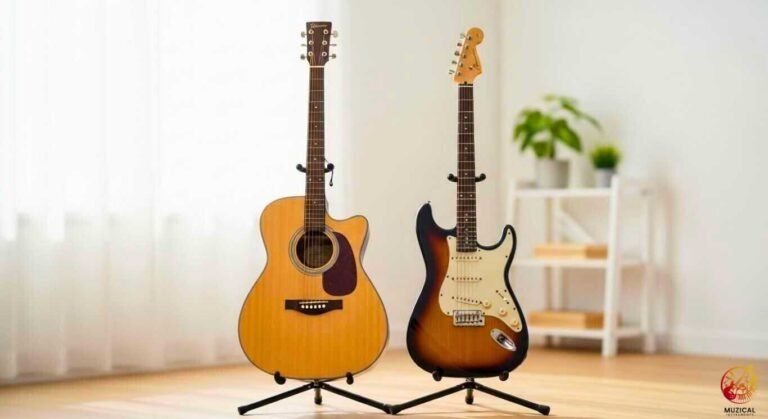
A “Full Size” acoustic guitar comes in different shapes. The shape changes how big it feels.
The Dreadnought
- The most common shape.
- Very wide and boxy.
- Loud sound.
- Verdict: Often too big for beginners, even adults.
The Concert / Folk
- Same neck length as a Dreadnought.
- Curvier body with a smaller waist.
- Sits lower on your leg.
- Verdict: Much more comfortable for most learners.
The Parlor
- Narrow body.
- Looks vintage.
- Very easy to hold.
- Verdict: Excellent for playing on the sofa.
Guitar Body Shape Comparison
| Body Shape | Sound | Comfort Level | Best For |
|---|---|---|---|
| Dreadnought | Boomy, Loud | Low (Bulky) | Tall adults, Strumming |
| Concert (000) | Balanced | High (Curvy) | Beginners, Fingerstyle |
| Parlor | Boxy, Mid-range | Very High (Compact) | Small adults, Blues, Travel |
How To Measure Your Arm Reach For The Perfect Fit
You can do a simple physical test to see if a guitar fits. This is the “Goldilocks” test for how to choose guitar size.
- Sit comfortably on a chair without arms.
- Hold the guitar on your right leg (if you are right-handed).
- Reach your right arm over the big part of the guitar body.
- Your elbow should rest comfortably on the top edge of the guitar.
The Check:
- If your elbow is sticking way up in the air: The guitar body is too big.
- If you have to stretch your shoulder forward: The guitar body is too deep.
- If your hand can easily reach the soundhole: The fit is good.
Next, extend your left arm to the headstock (where the tuning pegs are).
- If you have to fully lock your elbow straight to reach the first fret, the neck is too long.
- Your elbow should still have a slight bend when reaching the end of the neck.
Common Questions About 1/2 Size Guitars
A 1/2 size guitar is usually the first step for children aged 5 to 7.
Parents often ask: “Should I buy a bigger one so they grow into it?”
The answer is No.
If you buy a kid shoes that are two sizes too big, they trip and fall. If you buy a guitar that is too big:
- They cannot make the strings sound clear.
- They get frustrated.
- They think they are “bad at music.”
- They quit.
It is better to buy a cheap 1/2 size guitar now and upgrade later. A first guitar size tips rule of thumb: Fit for today, not for next year.
What About The Width Of The Neck?
Size isn’t just about length. It is also about width. This is the “Nut Width.”
Classical Guitars (Nylon String):
- These have very wide necks.
- The strings are soft, which is nice for fingers.
- But, the wide neck is hard for small hands to grab.
Steel String Guitars:
- These have narrower necks.
- Easier to wrap your hand around.
- Strings are sharper on the fingertips.
If you are looking for picking the right guitar size for a child with very small hands, a steel-string mini guitar might actually be easier to hold than a wide classical guitar, even though the strings are harder.
Top Recommendations For Beginner Models
Here are a few industry standards that are known for consistent sizing.
For Toddlers (Ages 3-5):
- Ukulele. (Seriously, start here. It’s perfect for tiny hands).
For Young Kids (Ages 5-8):
- Yamaha GL1 Guitalele: Half guitar, half ukulele. very small and fun.
- Yamaha CGS102A: A true 1/2 size classical guitar.
For Pre-Teens / Small Adults (Ages 9+):
- Yamaha JR1: A classic 3/4 size acoustic.
- Little Martin: High quality, small body.
- Baby Taylor: Great sound, 3/4 size.
- Squier Mini Strat: The best small electric option.
Finding The Right Guitar Size For Beginners: Final Advice
Picking the right guitar size for beginners is the very first step to becoming a musician. Do not guess based on what looks cool. Measure your height, check the chart, and think about the body shape.
If you are an adult under 5’4″, seriously look at Concert or Parlor sizes. If you are buying for a child, follow the kids guitar size guide strictly. A comfortable guitar makes practicing feel like play, not work. Go find the one that fits you best and start strumming.
FAQ: Right Guitar Size For Beginners
1. Can an adult play a 3/4 size guitar?
Yes, absolutely! Many adults actually prefer 3/4 size guitars. They are perfect if you have smaller hands or shorter arms. They are also great “travel guitars” because they are light and easy to carry on trips. Famous pop stars like Ed Sheeran play small guitars on big stages all the time.
2. How do I know if my guitar is too big for me?
Your body will tell you. If your right shoulder feels pushed up high near your ear, the guitar body is too big. Also, try to reach the end of the guitar neck with your left hand. If your arm is locked perfectly straight and feels tight, the guitar is too long. You should have a slight bend in your elbow.
3. What size guitar is best for a 10-year-old?
For most 10-year-olds, a 3/4 size guitar is the best choice. This size fits children who are between 4 feet 6 inches and 5 feet tall. If the child is very tall for their age, they might fit a small-bodied full-size guitar. Always measure height rather than guessing by age.
4. Does a smaller guitar sound different than a full-size one?
Yes, a little bit. Because the body is smaller, it cannot make deep, booming bass sounds like a big guitar. Smaller guitars usually sound quieter and have a brighter, sweeter tone. However, high-quality small guitars still sound wonderful for practicing and writing songs.
5. Should I buy a bigger guitar to “grow into”?
No, this is a bad idea. A guitar is not like a pair of pants. If a guitar is too big, it is physically painful to play. It makes pressing the strings down very hard. If playing hurts, a beginner will likely quit. It is always better to buy a cheap guitar that fits well right now.