What Is the Correct Drum Throne Height for Beginners?

The correct drum throne height puts your thighs parallel to the floor or angled slightly downward when you sit. Your knees should bend at 90 to 100 degrees. This position lets your legs move the pedals without lifting your heels or straining your hip flexors.
Your drum throne height controls how your entire body moves when you play. Set it wrong and your legs cramp after ten minutes. Set it right and you can practice for an hour without thinking about your seat.
Why Drum Throne Height Matters More Than You Think
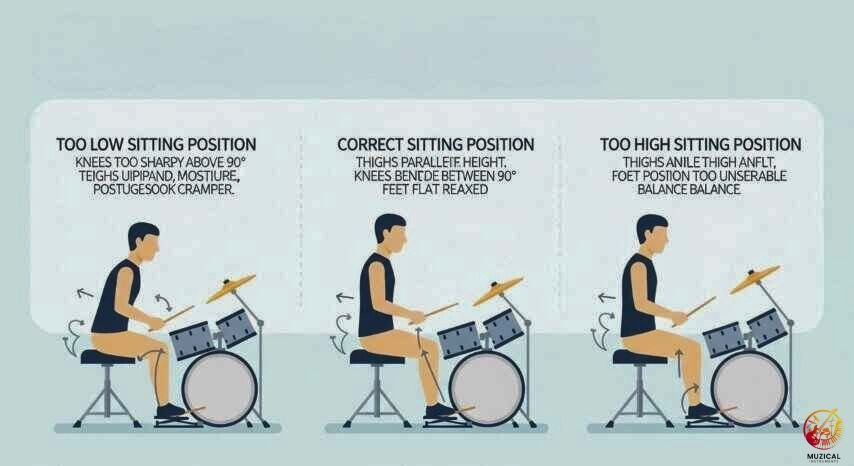
Your throne height changes how hard you can hit. When you sit too low, your knees rise above your hips. This position forces your lower back curves the wrong way. Your back starts hurting within minutes because your spine can’t hold its natural curve. You lose pedal control because you’re fighting your posture instead of playing.
When you sit too high, you reach down with your toes to hit the bass drum pedal. Your calves burn. You can’t use your whole leg for power. You end up playing lighter than you want because you’re stretching instead of pushing.
The right height lets you drop your heel and use your leg weight. You feel the pedal beater hit the drum head. You control the rebound. This is how you build speed on double bass patterns without your legs shaking.
Don’t copy your favorite drummer’s setup. Their body proportions are different. A throne height that works for someone with long femurs will wreck someone with short legs.
How to Find My Ideal Drum Throne Height
Sit on your throne with your feet flat on the bass drum and hi-hat pedals. Look at your thighs. If they slope down from hip to knee, you’re in the range. If your knees point up toward the ceiling, you’ve incorrect drum throne height.
Play a simple bass drum pattern for two minutes. Your heel should rest naturally on the pedal, not forced up or down. If you have to pull your heel up with effort, raise the throne half an inch. If your heel floats above the pedal, lower the throne.
Check your hip angle. When you sit correctly, your hip joint opens slightly. This feels like leaning forward from your pelvis, not hunching your back. If you feel pressure on your tailbone, you’re too low. If you feel like you’re perching on the edge, you’re too high.
Most beginner drummers sit too low because it feels stable. This stability costs you speed. Raise your throne until you feel slightly less planted. That’s where control lives.
The measurement trick: measure from floor to the top of your throne. For most adults, this falls between 18 and 22 inches. Kids need 14 to 17 inches depending on age. Write down your number. When you play at different locations, you can set up faster.
Drum Throne Height Starting Points by Drummer Size
Use these ranges as your starting point, then adjust based on how your body feels during play.
| Your Height | Throne Height (floor to seat) | Thigh Position | Knee Angle |
|---|---|---|---|
| 4’6″ – 5’0″ (kids) | 14″ – 16″ | Parallel or slight downward slope | 90° – 100° |
| 5’0″ – 5’6″ | 17″ – 19″ | Parallel or slight downward slope | 90° – 100° |
| 5’6″ – 6’0″ | 19″ – 21″ | Parallel or slight downward slope | 90° – 100° |
| 6’0″ – 6’4″ | 21″ – 23″ | Parallel or slight downward slope | 90° – 100° |
Common Setup Mistakes That Kill My Progress
You tilt forward and your back hurts after five minutes. This means your throne is too high or angled forward. Level the seat. Your weight should rest on your sit bones, not your thighs. Without a teacher watching your posture, you’ll repeat this mistake every practice session until you fix the throne angle.
You slide backward on the throne during fast songs. Your throne is too low and tilted back. Your body fights to stay balanced instead of playing. Raise it one inch and level the seat. Record yourself from the side to see if you’re sliding. Most drummers don’t notice this until they watch video.
You play with your heels constantly raised. This works for some advanced techniques, but if you are trying to play heel-down but your heels keep lifting involuntarily, your throne might be too high. Lower it until your heels rest naturally. Learn heel-down technique first. Heel-up playing comes later when you understand the difference. Online lessons often skip this detail because they can’t see your feet.
Quick Fixes for Common Throne Height Problems
When you feel discomfort during practice, this table shows you exactly what to adjust.
| Problem You Feel | What’s Wrong | Fix |
|---|---|---|
| Feet go numb after 10 minutes | Throne too low | Raise 1 inch |
| Heels float above pedals | Throne too high | Lower 1 inch |
| Back hurts, leaning forward | Throne too high or tilted | Lower and level seat |
| Sliding backward on throne | Throne too low | Raise 1 inch |
| Toes reach for bass pedal | Throne too high | Lower half inch |
| Knees point up toward ceiling | Throne too low | Raise 1 inch |
Why Is Drum Throne Height Important for a Child’s Learning?
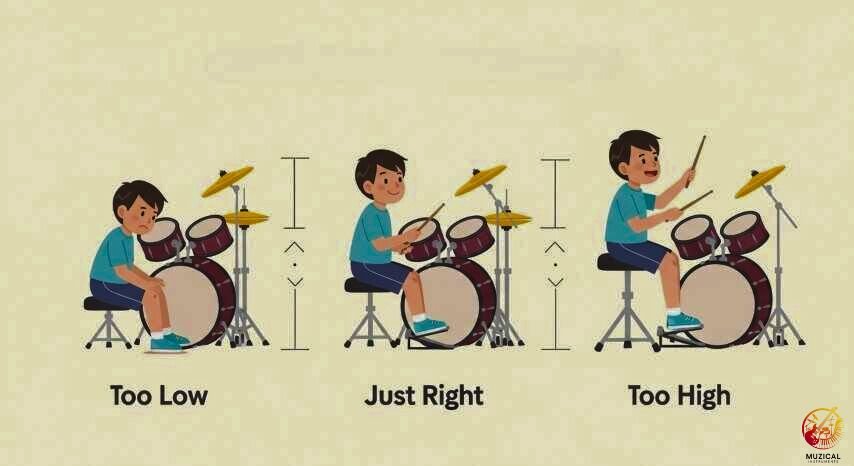
Your child’s throne height changes every six months as they grow. When their knees point up toward the ceiling, the throne is too low for their current height. Raise it one inch and recheck their thigh angle.
Kids complain about tired legs because their throne is usually too low, not because drumming is hard. Their lower back rounds forward and their thighs press into the seat edge. This blocks blood flow. After ten minutes, they want to stop. They think they’re weak, but the setup is wrong.
Measure from floor to seat top when you first set up the kit. Write this number on tape stuck to the throne post. Check it every month. Cheap thrones slip down from vibration. Your child won’t tell you the seat dropped half an inch. They’ll just struggle and quit.
Start with the table measurements for their height range. If they’re between sizes, go with the higher throne setting. Growing kids adapt faster to slightly higher seats than adults do.
Why My Setup Feels Wrong After Twenty Minutes
Your toes point inward or outward on the pedals after extended practice. This comes from rotating your hips to compensate for wrong throne height. Fix the height first. Your feet will naturally point forward when your hips open correctly. You’ve been adjusting your body to bad equipment instead of adjusting the equipment.
One leg feels more tired than the other after a practice session. You’re twisting to reach something. Usually the hi-hat is too far left or the throne is too low. Raise the throne and move the hi-hat closer to center. Home setups often copy drum shop floor models, which are arranged for display, not ergonomics.
Your lower back aches the next morning after practice. Your throne was too low last night. When your knees rise above your hips, your pelvis tilts backward. Your lower back compensates by flattening out. Over an hour of practice, this strains the muscles between your vertebrae. Raise the throne one inch before your next session.
How Drum Throne Height Connects to My Kit Setup
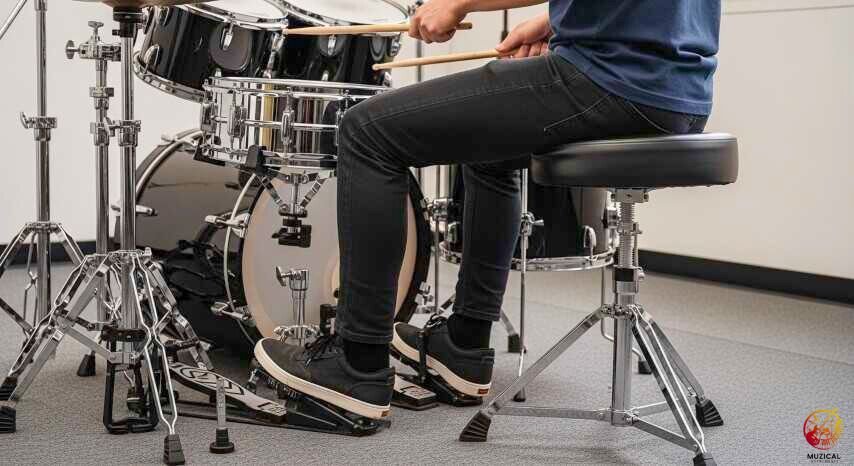
Your throne height determines everything else. Always set the throne height before touching any drum.
When your throne is at the correct height, your snare drum should sit between your thighs just below waist level. If you have to reach down to hit the snare, your throne is too high. If the snare touches your legs when you play, your throne is too low.
Your hi-hat cymbal should align slightly above the bottom of your rib cage, or generally 6 to 10 inches above the snare drum, high enough to cross your hands without your sticks clicking together. Beginners often set the hi-hat too low because their throne is too low. Raise the throne and the hi-hat automatically needs to come up.
Floor toms should require a small reach, not a lean. If you have to shift your weight to hit the floor tom, either the throne is too low or the tom is too far away. The throne height affects this because it changes how far you can reach comfortably.
Should I Change My Drum Throne Height as I Get Better?
Your ideal height changes as you learn new techniques. When you start, a lower throne feels secure. After three months, you’ll want it slightly higher to play faster bass drum patterns.
Raise your throne a quarter inch every few weeks. Stop when you feel unstable. Drop back to the previous height. This is your current maximum. As your balance improves, you can go higher.
Some drummers use different heights for different music. Jazz drummers often sit higher for brush work and ride cymbal control. Some metal drummers sit lower for powerful double bass. As a beginner, stick with one height until you can play for thirty minutes without discomfort.
When you practice standing up to stretch, sit back down and check if your throne moved. Cheap thrones slip down from vibration. Mark your preferred height with tape on the center post. You’ll know immediately if it shifted.
What Is the Best Drum Throne Height for Comfort and Control?
Set your throne so your thighs angle down slightly. Your knees bend at 90 to 100 degrees. Your heels rest on the pedals naturally. This position works for rock, pop, funk, and beginner jazz.
Avoid sitting lower just because it feels stable. That stability comes from muscle tension. Tension makes you tired and slow. Raise the throne until you feel balanced but not locked down.
Test any height adjustment by playing for twenty minutes. Your body lies in the first five minutes. Discomfort that appears after fifteen minutes means the height is wrong.
FAQ: Correct Drum Throne Height for Beginners
1. What is the best height for a drum throne?
For most adults, the best height is between 18 and 22 inches from the floor. The main rule is to check your legs. When you sit down, your thighs should be flat or slope down just a little bit. If your knees point up toward the ceiling, you need to raise the seat.
2. How do I know if my drum seat is too low?
Your body will tell you. If your knees are higher than your hips, the seat is too low. This forces your lower back to curve the wrong way. It also makes your hip muscles work too hard to lift your legs. If you feel like you are doing a squat while playing, raise the throne.
3. Why does my back hurt when I play drums?
Back pain usually happens because you are fighting for balance. If your seat is too low, you slouch. If it is too high, you might lean forward to reach things. Try leveling your seat so it is flat. Then, adjust the height until your back feels straight and relaxed, not curved.
4. Does sitting higher help me play faster?
It often does. When you sit a little higher, you can use the weight of your whole leg to hit the pedals. This takes less energy than using just your ankles. It helps you play louder and faster for a longer time without your shins burning.
5. Should my heels be up or down when I play?
This depends on how you want to play, but your seat height changes how it feels. If you want to play with your heels down, sit a bit lower so your ankles can flex. If you want to play with heels up for power, sit a bit higher so your legs can move freely. The right height lets you choose either way easily.