Drum Stick Grip Techniques Every Beginner Should Learn

The way you grip drum sticks determines how fast you can play, how much power you create, and whether your hands hurt after practice. Two main grip styles exist: matched grip and traditional grip. Beginners should start with matched grip because it feels natural and works for all drum types.
Most new drummers focus on what to hit, but how to hold drum sticks is actually the most important step. If you get the grip wrong, you limit your speed and risk hurting yourself.
Learning proper drum stick grip techniques fixes these problems and lets you play longer without pain.
What is the Correct Drum Stick Grip? (The Fulcrum)
The correct drum stick grip relies on a pivot point called the “fulcrum.” This is the specific spot where your thumb and index finger meet the stick to let it bounce freely. Without a good fulcrum, the stick won’t rebound, and you have to work twice as hard.
Finding Your Fulcrum: The Balance Point
Before we talk about styles (like German or French), we have to find the balance point. In our experience teaching kids and teens, skipping this step is the #1 reason for bad habits.
How to find it:
- Hold the stick with your non-playing hand.
- Use the index finger of your playing hand to balance the stick.
- Move your finger until the stick balances perfectly flat (like a see-saw).
- This spot, usually about one-third of the way up from the bottom of the stick, is your fulcrum.
The “Pick Up a Penny” Test
To feel the right pinch, pretend you are picking up a penny off a flat table. Notice how your thumb and index finger come together? That is exactly how you should hold the stick at the fulcrum point.
Experience Marker: If you hold the stick too far back (near the butt end), it will feel heavy and won’t bounce. If you hold it too far forward, you lose all your power. We have found that marking the “sweet spot” on the stick with a sharpie or piece of tape helps beginners remember exactly where to grab every time.
Matched Grip: The Best Beginner Drum Grip
Matched grip means holding the stick exactly the same way in both hands. This is the standard drum grip for beginners because it is natural, easier to learn, and works for rock, pop, and electronic music.
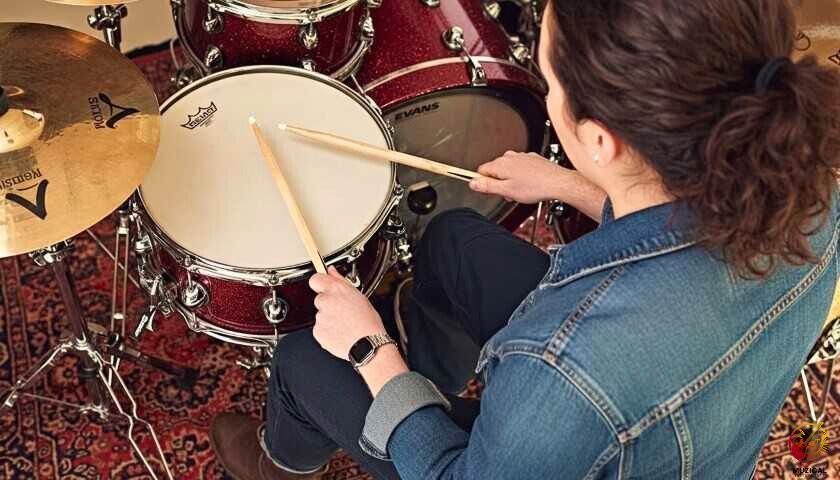
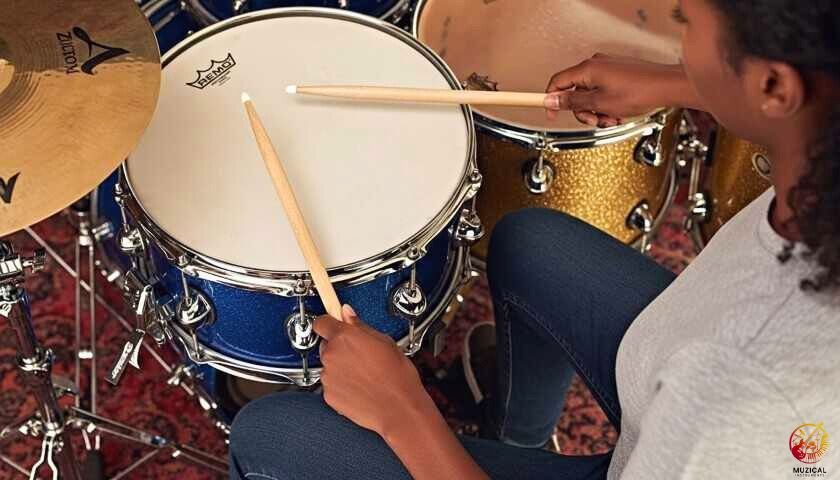
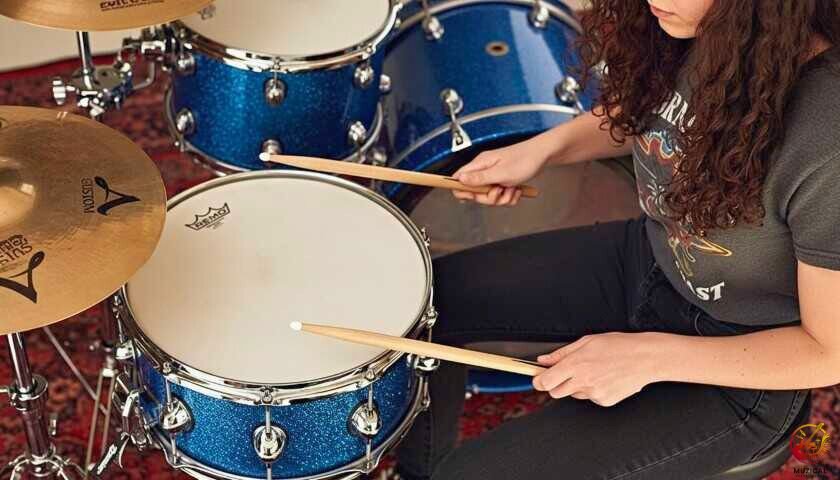
There are three main versions of matched grip. We will test which one feels right for you.
1. The American Grip (The Middle Ground)
This is the most versatile beginner drum grip. If you take lessons, this is likely what your teacher will show you first.
- How to do it: Hold your sticks out. Your palms should be facing the floor at a 45-degree angle.
- The Motion: It uses a mix of your wrist and fingers.
- Why use it: It offers the best mix of power and speed. It is comfortable for moving around the toms.
2. The German Grip (Power and Volume)
- How to do it: Turn your hands so your palms are facing flat against the floor. Your elbows might stick out a little bit.
- The Motion: This is almost entirely wrist motion. Think of the motion you use to knock on a door or dribble a basketball.
- Real-World Scenario: We use this when playing loud rock beats or heavy backbeats on the snare. It gives you maximum volume with less effort.
3. The French Grip (Speed and Finesse)
- How to do it: Turn your hands so your thumbs are on top of the stick, facing the ceiling. Your palms face each other.
- The Motion: This uses mostly fingers.
- Real-World Scenario: This is great for playing fast patterns on the Ride cymbal or playing softly (jazz or acoustic gigs). It is not great for heavy hitting.
Comparison Table: Which Grip Should I Use?
| Grip Style | Hand Position | Best For | Difficulty Level |
|---|---|---|---|
| American | Palms at 45° angle | Everything (Rock, Pop, Funk) | Easy (Start Here) |
| German | Palms flat down | Loud Volume, Heavy Rock | Low |
| French | Thumbs up | Speed, Ride Cymbal, Jazz | Medium |
Should Beginners Learn Traditional Grip?
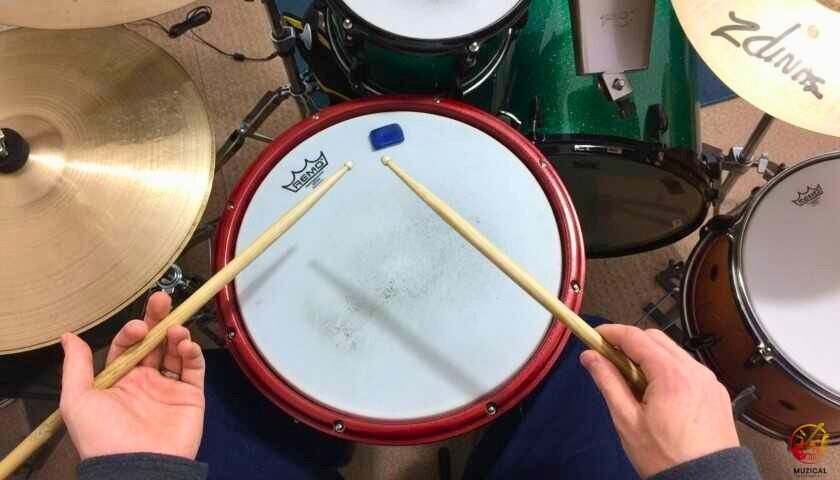
No, not yet. Traditional grip (where the left hand holds the stick under the thumb like a chopstick) is harder to learn. Unless you are joining a marching band snare line or studying classic jazz, stick to matched grip.
Why We Recommend Matched Grip First
In our years of playing, we have seen self-taught players try traditional grip because it “looks cool” like their favorite jazz drummer. The result? They often develop wrist pain because the motion is not natural.
The Anatomy Check:
Matched grip works with the natural hinge of your wrist. Traditional grip requires a rotating motion (like turning a doorknob). For a beginner drum grip, mastering the simple hinge motion first builds confidence faster. Once you have good control, you can always learn traditional grip later.
The “Loose Grip” Rule: How Tight is Too Tight?
You should hold the sticks loosely enough that someone could pull them out of your hands with a gentle tug, but tight enough that you don’t drop them when you hit the drum.
The “Baby Bird” Analogy
Imagine you are holding a baby bird.
- Too tight: You crush the bird (and stop the stick from bouncing).
- Too loose: The bird flies away (and your stick flies across the room).
Why the “Death Grip” hurts you
When beginners get nervous or try to play fast, they naturally squeeze the stick harder. This is called the “Death Grip.”
The Result of Squeezing:
- Shockwaves: When you hit the drum, the vibration has nowhere to go. It travels straight up the stick and into your wrist and elbow. This causes soreness and can lead to injury (like tendonitis) over time.
- Choked Sound: A tight grip stops the stick from vibrating. The drum will sound “dead” or “choked” rather than full and resonant.
- Blisters: Friction causes blisters. If you are getting blisters in the middle of your palm or on your thumb within 20 minutes of playing, you are gripping too hard.
Experience Marker: We once worked with a student who kept breaking sticks every week. We realized he was squeezing the stick so hard that the wood couldn’t absorb the shock, so it snapped. As soon as he loosened his grip, his sticks lasted months, and his speed increased immediately.
Troubleshooting: Why Do My Sticks Keep Slipping?
Slipping usually happens because your hands are dry, you are sweating too much, or your fulcrum is “wandering.”
Even with proper drum stick grip, gravity is an enemy. Here is how to fix it without changing your technique.
1. The Sweat Factor
If your hands get sweaty, the lacquer on standard drum sticks becomes slippery.
- The Fix: Keep a small towel on your snare drum or in your pocket. Wipe your hands between songs.
- Gear Tip: You can buy “grip tape” (similar to tennis racket tape) to wrap the handle of your sticks.
2. The Dry Hand Factor
Surprisingly, super dry hands are also slippery because there is no friction.
- The Fix: Some drummers use a specific wax (often called “sex wax” for surfers or “gorilla snot” for drummers) that makes the stick tacky.
3. The Wandering Fulcrum
Sometimes, as you play, your hand slides down to the bottom of the stick.
- The Fix: Check your grip every 5 minutes. If you see about 2 inches of stick sticking out from the back of your hand, you are good. If you see no wood at the back, you have choked up too far. Reset to the balance point.
3 Exercises to Improve Your Drum Stick Grip Techniques
You don’t need a drum set to practice how to hold drum sticks. You can do these on a practice pad or even a pillow.
Exercise 1: The Rebound Test (The Free Bounce)
This proves if your fulcrum is working.
- Hold the stick in the American position.
- Lift the stick and throw it down at the pad.
- The Goal: Do not stop the stick. Let it bounce freely as many times as it can on its own (like a basketball).
- If it only bounces once and stops, you are squeezing too hard. loosen your back fingers.
Exercise 2: 8-on-a-Hand
This builds muscle memory for the correct drum stick grip.
- Play 8 hits with your Right hand.
- Play 8 hits with your Left hand.
- Repeat without stopping.
- Focus: Watch your hands. Is your left hand holding the stick exactly like your right hand?
The Payoff: Isolating each hand allows you to visually compare your “weak” hand against your “strong” hand. This immediately exposes if your wrist is twisting or your grip is slipping, ensuring both hands develop equal power and speed from day one.
Exercise 3: The Finger Control Check
- Hold the stick using only your thumb and index finger (your fulcrum).
- Stick your other three fingers straight out (like you are drinking tea).
- Try to play a beat using only that pinch.
- Why do this? This strengthens your fulcrum. After 30 seconds, wrap your other fingers back around gently. You will feel how much support they offer without squeezing.
Verdict: Which Grip Should You Start With Today?
If you are looking for the single best beginner drum grip, start with the American Matched Grip.
- Step 1: Find the balance point (fulcrum) with the “pick up a penny” pinch.
- Step 2: Wrap your back fingers gently (don’t squeeze!).
- Step 3: Turn palms to a 45-degree angle.
- Step 4: Strike the drum and let it bounce.
Mastering drum stick grip techniques takes time. Do not get discouraged if it feels awkward for the first week. Your muscles are learning a new language.
Keep your hands relaxed, watch for that wandering fulcrum, and listen to the sound of the drum. A relaxed grip equals a big sound.
FAQ: Drum Stick Grip Techniques
1. What is the best drum stick grip for beginners?
The American Matched Grip is the ideal starting point. It positions your palms at a natural 45-degree angle, offering the best balance of power and speed. In our experience, this “middle ground” grip is easier to learn than German or French styles because it uses a natural wrist motion similar to waving, making it perfect for rock, pop, and electronic music.
2. How tight should you hold drum sticks?
Hold the stick loosely enough to let it bounce, but firmly enough that you don’t drop it, imagine holding a baby bird. If you feel shock or vibration traveling up to your elbow when you hit the drum, you are squeezing too hard. A relaxed grip absorbs shock and allows the drum to resonate fully.
3. Why do my drum sticks keep slipping?
Slipping is usually caused by sweat, dry skin, or a wandering fulcrum. If your hands are sweaty, keep a towel nearby; if they are dry, use stick wax for tackiness. We also recommend checking your grip frequently: if the butt end of the stick disappears into your palm, you have choked up too far and lost your leverage.
4. Is Traditional Grip harder to learn?
Yes. Traditional Grip requires a complex under-hand rotation (like turning a doorknob) that is mechanically different from the right hand. Unless you are specifically studying for marching band or classic jazz, we recommend mastering Matched Grip first to build confidence and control without the steep learning curve.