Common Sitting Mistakes Beginner Drummers Make

You sit wrong at your drum kit and your back hurts after 20 minutes. Your arms feel tired before you finish a song. These problems come from how you position your body, not from lack of skill.
Most beginner drummers copy what they see without understanding why certain positions work. You end up with sore muscles, missed hits, and slower progress.
This guide identifies common sitting mistakes beginner drummers make and what happens when you fix them.
Quick Overview: Common Sitting Mistakes & Solutions
The following table outlines the key posture errors that hinder progress and how to correct them:
| Common Mistake | Why It Hurts Your Playing | How to Fix It |
|---|---|---|
| Sitting Too Close | Locks elbows against ribs, forcing wrist-only motion and causing forward hunching. | Move back until knees clear the bass drum by about 2 inches and elbows hang naturally. |
| Incorrect Throne Height |
Too high: causes instability. Too low: causes hip cramping and lower back pain. | Adjust height so thighs slope down slightly (5–10°) and knees stay below hips. |
| Slouching | Compresses lungs, reduces endurance, and causes fast back fatigue. | Lift your chest, pull shoulders back, and sit on the front half of the throne. |
| Incorrect Foot Placement | Creates ankle wobble, slows pedal speed, and wastes energy sideways. | Point toes straight or slightly out (max 15°) and place the ball of the foot on the pedal. |
| Leaning to One Side | Curves the spine, causes uneven reach, and strains the lower back. | Distribute weight evenly on both hips and reposition drums to avoid overreaching. |
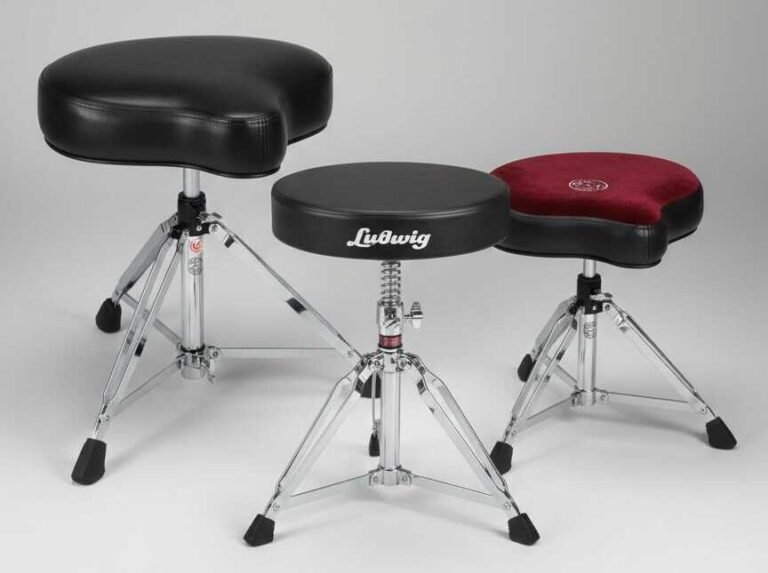
| Improper Seat (No Throne) | Household chairs limit movement, cause leg numbness, and lack stability. | Use a dedicated, adjustable, padded drum throne with a sturdy base. |
Sitting Too Close to the Drum Kit Is a Common Sitting Mistake Beginner Drummers Make
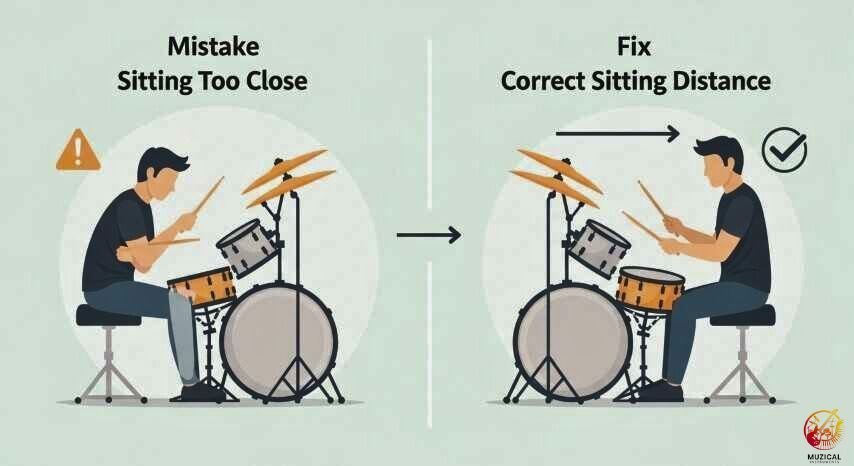
Beginner drummers sit too close because they think closer means better control, but this is one of the common sitting mistakes beginner drummers make. If you sit close your knees bump the bass drum. Your elbows stay locked against your sides. You can’t extend your arms to reach cymbals without leaning forward.
This position forces you to play with your wrists only. Your shoulders curl inward. After 15 minutes, your upper back burns. You also hit drums at weak angles because your arms can’t swing naturally.
Sit far enough back so your knees clear the bass drum by two inches. Your elbows should hang naturally by your sides, and your sticks should land in the center of the snare without you having to reach forward. This distance lets you use your whole arm, not just your wrist. You’ll hit harder with less effort.
Some drummers need to sit closer because they’re shorter. That’s fine if your arms still extend and your knees don’t touch anything. The test is movement, not distance.
Incorrect Throne Height Is One of the Most Common Sitting Mistakes Beginner Drummers Make
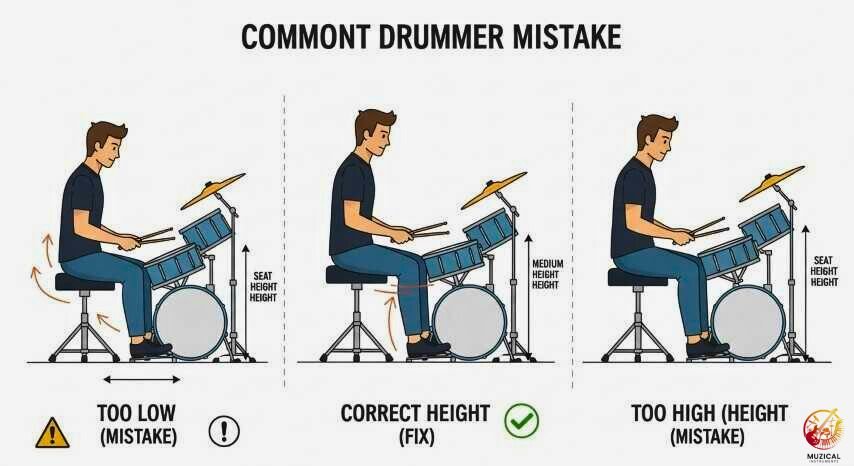
When the height is wrong your balance, power, and comfort all break down. This sitting mistake is common among beginner drummers.
You sit at the wrong height when you set the throne once and forget it. Sitting too high makes your thighs slope down too much. Your feet barely reach the pedals. You lose control and speed.
Sitting too high makes you unstable, forcing you to use your hands to balance rather than play.
Sitting too low causes a different problem. Your knees rise above your hips. Your hips and legs cramp fast. Your lower back rounds, and pain shows up quickly. Your legs also block your arms from moving freely.
Set your throne so your thighs slope down a little, about 5 to 10 degrees. Keep your feet naturally resting on the pedals. Knees stay below hips. Adjust again every few weeks as your body changes.
Slouching Is the Fastest-Pain Sitting Mistake Beginner Drummers Make
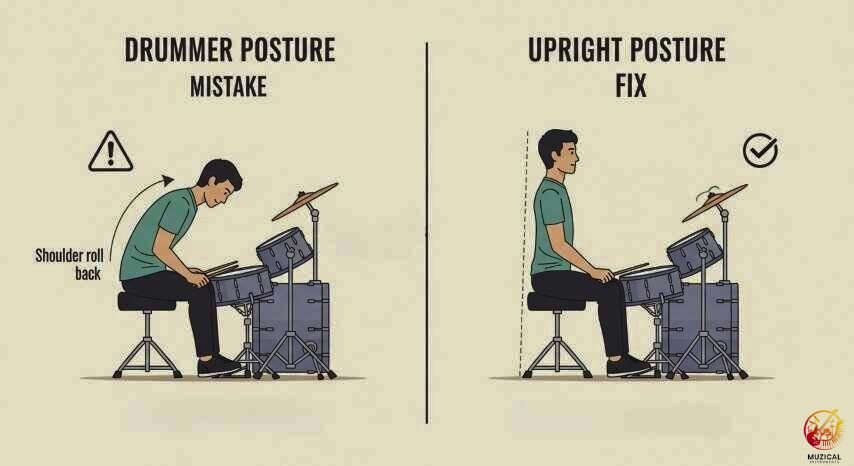
Because slouching weakens your body and limits how you move and breathe. Among common sitting mistakes beginner drummers make, this one causes pain the fastest and reduces endurance.
You slouch when you watch your hands and feet and forget your back. Your shoulders roll forward. Your chest sinks in. Your head drops down. This bends your whole spine into a curve.
When you slouch, your lungs cannot fill fully. You take short breaths. You get tired faster, especially during long fills. Your shoulders also stop turning well. This makes it harder to reach the ride cymbal or floor tom.
Pain shows up fast. After about 10 minutes, your mid-back starts to hurt. After 30 minutes, your neck feels sore from looking down. You may not feel it right away, but your body remembers it later.
Sit on the front half of the throne. Let your hips tilt forward. Pull your shoulders back. Lift your chest. Keep your head level. It feels strange at first, but it gets easy with practice.
Incorrect Foot Placement on Pedals Is a Common Sitting Mistake Beginner Drummers Make
The wrong foot position slows you down and makes your ankles wobble. Many beginner drummers make this sitting mistake.
Your feet might point outward like a duck or inward like you’re pigeon-toed. Sometimes you copied someone else or it just happened naturally. Your heels lift off the pedals, and your ankles wobble side to side.
Wrong positioning reduces pedal speed. Your ankle can’t move straight up and down. You waste energy on sideways motion. Your foot may even slip off the pedal during fast parts.
To fix your foot placement:
- Point toes straight ahead or slightly outward (no more than 15°).
- Place the ball of your foot on the pedal, not your toes or arch.
- Keep your heel down for heel-down technique, or lift straight for heel-up.
- Avoid twisting your ankle.
Some drummers need slightly different angles due to hip shape. The key is stability. Test by playing sixteenth notes for 30 seconds, adjust if your foot slides or your ankle hurts.
Leaning to One Side Is a Common Sitting Mistake Beginner Drummers Make That Strains the Back
Because uneven weight strains your back and limits your reach. Leaning is one of the common sitting mistakes beginner drummers make that strains the back and limits reach.
You might lean to your right or left without realizing it. One hip carries more weight. One shoulder sits higher. It feels normal because you’ve done it for months, but your body isn’t centered.
Leaning causes:
- Lower back strain on the weighted side
- Spine curving sideways
- Uneven reach and overextension
- Harder hits on one hand
To fix it:
- Sit with equal weight on both hips
- Keep your spine vertical and shoulders level
- Check yourself in a mirror or ask someone to watch
- Place your throne centered behind the snare and bass drum
- Move drums closer instead of leaning to reach them
- Reposition your kit so your body stays neutral
Practicing with balanced posture prevents long-term pain and improves control and consistency.
Not Using a Proper Drum Throne Is a Common Sitting Mistake Beginner Drummers Make That Breaks Balance
If you sit without a proper drum throne, it will ruin your posture, balance, and playing. This is one of the common sitting mistakes beginner drummers make that affects every part of playing.
Sitting on a kitchen chair, piano bench, or cheap stool feels normal, but these seats cause problems:
- Flat hard surfaces create pressure points on your sit bones
- Legs go numb after 15 minutes
- You shift constantly, breaking balance and rhythm
- Backrests or wide seats limit shoulder and arm movement
- Cheap stools wobble or collapse under heavy playing
A proper drum throne solves these issues:
- Padded round seat spreads pressure evenly
- Adjustable height fits your body and kit
- Sturdy base stays stable when hitting pedals
- Round shape allows slight weight shifts for comfort
Avoid backrests unless medically necessary. Sit on the front half to stay active. A good throne lets you focus on drumming, not discomfort.
Fixing Common Sitting Mistakes Beginner Drummers Make Helps You Play Longer Without Pain
If your back hurts after short sessions, your arms feel tired too fast, or your hits feel weak, these are signs of common sitting mistakes beginner drummers make, not lack of talent. When your position is right, your body feels stable and your movements feel easier. That is how drumming should feel.
Choose a setup where your knees clear the bass drum, your thighs slope slightly down, and your back stays upright without effort. Keep your feet natural on the pedals and your weight balanced on both hips. Use a proper adjustable drum throne and sit on the front half so your body can move freely.
It may feel awkward at first. That is normal. If it feels different, it means your body is correcting old habits. Give it two weeks. If pain reduces and control improves, you are on the right path. If something still hurts, adjust again. Good sitting never causes sharp pain or fast fatigue.
Fix these common sitting mistakes beginner drummers make, and you will play longer, hit with more control, and enjoy drumming without fighting your own body.
FAQ: Common Sitting Mistakes Beginner Drummers Make
1. What is the correct way to sit at a drum set?
Sit up straight but keep your body relaxed. Your back should be flat, not curved like a turtle shell. Keep your shoulders down and loose. Make sure your hips are a little bit higher than your knees. This helps you move your feet faster without getting tired.
2. How high should my drum throne be?
Adjust your seat so your thighs slope downward just a little bit. Your hip bone needs to be higher than your knee cap. If you sit too low, your legs have to work extra hard to lift up. If you sit too high, you might feel wobbly and lose your balance.
3. Why does my back hurt when I play drums?
Back pain usually happens because you are slouching. If you round your shoulders forward, your lower back gets tight. Try to sit tall, like a string is pulling the top of your head up. Also, check that you aren’t reaching too far for your drums.
4. Should I sit on the edge of the drum stool?
Yes, it is better to sit near the edge of the seat. This leaves your thighs free to move up and down. If you sit too far back, the cushion cuts into the back of your legs and slows you down. Just make sure you are stable and won’t slip off.
5. How far away should the snare drum be?
Sit close enough that your elbows hang naturally by your ribs. You should be able to hit the center of the drum without reaching your arms out straight. If your elbows are pulled way back behind you, you are sitting too close.