Piccolo vs Flute: Key Differences You Must Know

The flute is longer and makes soft, smooth sounds, while piccolo is smaller and plays higher, brighter notes.
Though they look alike, they feel very different. Flute is easier to control and blends well with other instruments. Piccolo is sharper and stands out in a band.
Piccolo vs Flute differences appear as soon as you play your first note. Your choice changes how you sound, how you hold the instrument, and how you practice. Both are different and each has its own role in music.
Quick Look: Piccolo vs Flute
| Feature | Flute | Piccolo |
|---|---|---|
| Physical Length | Approximately 26 inches long | Exactly half the size of a flute |
| Musical Pitch | Standard “C” concert pitch | Plays one full octave higher |
| Material | Usually silver-plated nickel | Often made of grenadilla wood |
| Learning Curve | Easier for absolute beginners | High difficulty; requires tight lips |
| Air Requirement | Requires a large volume of air | Requires high-pressure, fast air |
| Common Use | Orchestras and solo recitals | Marching bands and solo highlights |
| Case Size | Long, rectangular hard case | Tiny, compact case fits in a pocket |
| Volume Level | Mellow and blends easily | Piercing and extremely loud |
| Price Point | Very affordable beginner models | Expensive due to specialized parts |
| Hand Comfort | Wide, natural finger spacing | Very cramped, tight finger spacing |
What Is The Main Difference Between Piccolo And Flute?
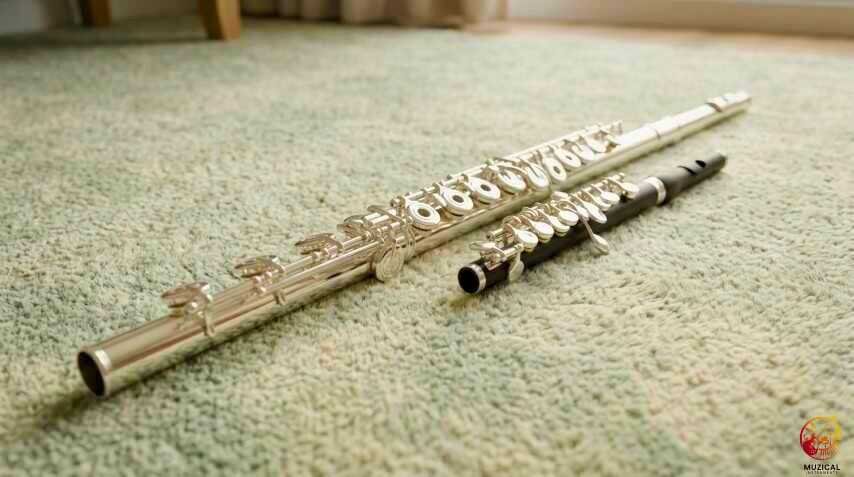
The primary difference between piccolo and flute is size and pitch. A standard flute measures about 26.5 inches, while a piccolo is roughly half that length. That shift in scale does more than change how the instrument looks; it pushes the piccolo to sound one full octave higher. Same fingering, yes, but the feel is not the same. You use tighter lips, faster air, and far more control. It can feel a bit unforgiving.
The “Cramped” Hand Position
- The Flute Feel: Your hands sit apart in a relaxed way. Breathing feels open, almost natural.
- The Piccolo Feel: Everything moves closer. Your fingers bunch together near your face. For players with larger fingers, this feels incredibly cramped.
- What tends to happen: New players often clip the wrong keys, especially trill keys.
The Acoustic Role: Blending vs. Piercing
- Flute (Blending): Its tone spreads and mixes. It slips into the sound of strings or woodwinds without much effort.
- Piccolo (Cutting Through): It doesn’t really “hide.” Its upper notes sit above everything else, almost by design.
- In practice: A missed flute note might pass unnoticed. A piccolo slip? That carries. Even to the back row.
Material Differences
While most student flutes are made of silver-plated nickel, piccolos vary wildly.
- Student Piccolos: Often metal or plastic. Built to handle outdoor use.
- Professional Piccolos: Usually grenadilla wood. Not for looks, more to soften the sharp edge of its sound.
What Does Piccolo Sound Like Compared To Flute?
The piccolo simply sounds one octave higher than the flute. In practice, that shift changes everything. The tone doesn’t just rise, it sharpens. What feels gentle on a flute can turn bright, even a little harsh, on piccolo. Blending becomes harder. Sometimes, it almost resists blending altogether.
The Acoustic Laser vs. The Warm Blanket
- Flute (Omnidirectional): The sound tends to spread. It fills space rather than pushing through it. That softer edge, fewer biting overtones, lets it sit comfortably with strings or clarinets.
- Piccolo (Directional): The sound projects forward, almost in a straight line. Its pitch range falls where human hearing is especially sensitive (2,000 to 4,000 Hz), a single piccolo can easily out-volume a 100-piece marching band or a full symphony orchestra.
The “Pianissimo” Problem
- Flute Advantage: On a flute, you can whisper out a high note at a true pianissimo (very soft) volume.
- Piccolo Reality: High notes need fast air. Fast air tends to carry. So “soft” playing, especially up high, often isn’t truly soft, it just feels controlled.
Where They Shine
- Flute: Lyrical lines, chamber settings, jazz textures.
- Piccolo: Climactic peaks, especially in works by Pyotr Ilyich Tchaikovsky or marches by John Philip Sousa.
Is Piccolo Harder To Play Than Flute?
Yes, the piccolo is significantly harder to master than the flute. Not because of fingerings; those stay the same. The difficulty comes from control. Everything feels smaller, tighter, less forgiving. For many players, that shift takes time to adjust to, and it can be frustrating early on.
The “Laser Beam” Embouchure
- Flute Feel: You blow across a fairly open space. The air stream can stay relaxed, even on higher notes.
- Piccolo Feel: The opening shrinks. You must blow a highly pressurized “laser beam” of air into a fractionally small tone hole.
- What you notice: Lip muscles tire quickly. It’s common, almost expected, for beginners to feel soreness after short sessions.
The Intonation (Tuning) Challenge
- Margin of error: If you pull the headjoint out by one millimeter on a flute, it adjusts the tuning slightly. If you move a piccolo headjoint by one millimeter, the pitch swings drastically.
- Exposure: If you play slightly flat on a flute in a concert band, the other flutes will cover you up. If you play flat on a piccolo, because it sits an octave above the entire band, it will pierce through the room and everyone will hear it.
The Earplug Consideration
This is the detail most beginner guides miss: Piccolos can cause hearing damage.
- The Decibel Level: Playing a piccolo in its third octave inside a small, tiled practice room can easily exceed 100 decibels (similar to a lawnmower).
- Our Recommendation: We mandate that our students wear high-fidelity musician earplugs (such as Etymotic or Earasers) in their right ear (the ear closest to the instrument) during solo practice sessions to prevent tinnitus.
Should You Choose Piccolo Or Flute For School Band?

You must start with the flute. School band programs require students to build their foundational embouchure (lip muscles) and breath control on the standard flute for at least 1 to 2 years. Furthermore, a typical concert band needs 8 to 12 flutes, but only requires 1 or 2 piccolos.
The “Doubler” Reality
- Expectation: Piccolo isn’t usually a full-time role. Directors often treat it as a secondary assignment.
- The Reality: During a holiday concert, you will likely play standard flute for the lyrical ballads, and keep the piccolo resting on your lap or a peg stand
The Marching Band Exception
- Flute limitation: Outdoors, the flute’s sound can fade quickly. Its direction and softer edge don’t carry far across a field.
- Piccolo use: The smaller instrument projects more directly. It’s also lighter, which matters when you’re marching for long periods.
How to Get Selected for Piccolo
- Focus first: Strong tuning on flute tends to matter more than speed or range.
- Why it counts: Piccolo pitch can shift easily, so directors often choose players who already show careful listening and steady control.
How Does Size Affect Playing In Piccolo Vs Flute?
Size changes everything, but not always in the way you expect. The flute’s longer body pushes your arms outward, which can lead to a slow, creeping tension in the right shoulder. The piccolo removes that stretch. Relief? Partly. Yet the strain doesn’t disappear; it shifts.
The Posture Trade-Off: Shoulders vs. Hands
- Flute (Leverage): The instrument extends to your right, creating a kind of imbalance. Over time, that offset weight may pull on the upper back and neck, especially in longer rehearsals.
- Piccolo (Compact Hold): With less length, your arms draw inward. That sounds easier, but it often forces tighter wrist angles. The position can feel restricted, almost cramped, after a while.
The “Right Pinky” Cramp
- Spacing: On flute, your fingers rest with some breathing room. On piccolo, that space nearly disappears.
- What you feel: The right hand works harder than expected. The pinky, in particular, stays engaged more consistently, which can lead to fatigue during fast passages.
The Balance Point (The Left Index Finger)
- Flute: Its weight helps it settle naturally against your hand and chin.
- Piccolo: Lighter, yes, but also less stable. It may feel slightly unsteady, so you end up gripping more than you intended.
Which One Is Louder: Piccolo or Flute?
The piccolo is drastically louder in practical application. While a standard flute peaks around 85 to 90 decibels, a piccolo playing in its upper register easily exceeds 100 decibels.
What really stands out is how the sound is perceived. A high piccolo note can cut through a full ensemble in a way a flute rarely does.
The Physics of “Loudness” (Frequency vs. Decibels)
- Flute (Easily Masked): Its sound sits among other instruments, violins, clarinets, even trumpets. Because of that overlap, it can disappear into the group, especially during louder passages.
- Piccolo (Hard to Ignore): Its highest notes occupy a range with less competition. That placement may explain why it feels sharper, almost exposed, even when not played forcefully.
“Stand Partner” Hazard
- The player: Close-range volume can become tiring. Some players quietly use ear protection during practice.
- Nearby musicians: Sitting next to a piccolo isn’t always pleasant. Many flutists instinctively lean away during louder sections.
The 1-to-10 Ensemble Ratio
- Flutes: Bands often include 8 to 12 flutes to build a blended section sound.
- Piccolo: Usually just one. Adding more can create a tense, wavering effect in the pitch, which audiences tend to notice quickly.
What Problems Does Each Instrument Solve?
The flute solves the problem of harmonic blending, providing a warm, cylindrical foundation for woodwind choirs and lyrical solos. The piccolo solves the problem of acoustic projection. It acts as the sonic “capstone,” cutting through dense brass and percussion where standard flutes would be completely inaudible.
The Flute: The “Harmonic Glue”
- What it handles: The flute often carries lines that need to sit within the ensemble rather than above it. Its tone can feel smooth enough to merge with clarinets or strings without drawing attention.
- Where it struggles: That same softness can work against it. In louder settings, especially with brass, the sound may fade into the background more than intended.
The “Tutti” Survival Reality
- Flute experience: In full ensemble passages, what musicians call “tutti” (a musical passage where the entire 80-piece band plays at once at fortissimo volume), flutes sometimes feel present physically but less so acoustically. You play, but the result may not travel far.
- Piccolo role: This is where the piccolo tends to step in. Its higher placement allows it to remain audible when the texture thickens.
Who Should Avoid Piccolo Vs Flute Choices?
Beginners should always avoid piccolo. It is very hard to control at first.
Also if you are sensitive to loud sounds, the high pitch can hurt your ears and you will find it uncomfortable. If your fingers are wide or you have braces, playing can feel painful.
The flute can also cause issues for some players. You hold it to the side, which can strain your body. If you have shoulder pain or neck tension, this position may feel uncomfortable.
Who Must Avoid the Piccolo?
- Braces (Orthodontic Work): The embouchure opening is extremely small. Metal brackets can rub against the inner lip under pressure, which many players find painful after only a few minutes. Waiting it out with a flute often makes more sense.
- Sound Sensitivity: High frequencies, especially at close range, can be uncomfortable. If you already deal with tinnitus or migraines, piccolo playing may aggravate that.
- Larger Fingertips: The tight spacing can lead to accidental key presses. It’s not impossible to manage, but it may slow progress early on.
Who Should Reconsider the Flute?
- Shoulder or Neck Issues: The sideways playing position can place steady strain on the right shoulder. Over time, that posture may worsen existing tension.
Can A Flute Player Easily Switch To Piccolo?
At first, it might look easy, same fingerings, same family. That assumption doesn’t quite hold up in practice. The transition tends to feel awkward, even for experienced flutists. Tone control, in particular, can take months to settle. Early attempts often sound thin or overly sharp, which can be discouraging if you’re not expecting it.
The Placement Shift (The “Higher on the Lip” Rule)
- Flute embouchure: The lip plate usually rests just below the edge of your lower lip. It feels stable, almost fixed.
- Piccolo embouchure: The instrument sits slightly higher. There’s less surface to anchor it, so balance becomes an issue.
- What happens: At first, it may feel like the piccolo won’t stay in place. Finding a consistent position takes repetition more than force.
Air Speed vs. Air Volume
- Flute habit: More air often helps, especially in louder passages.
- Piccolo adjustment: Less air, but faster. That difference is subtle,and easy to misjudge.
- Result: Too much air can break the tone quickly, producing a sharp, unstable sound.
The Fingering Exceptions (The Extreme High Register)
- Lower range: Familiar fingerings generally work as expected.
- Upper range: Things shift. Some notes respond unpredictably, so players often rely on alternate fingerings to stay in tune.
The Final Verdict: Piccolo vs Flute (Decision Matrix)
Choosing between piccolo and flute isn’t just personal preference. It often comes down to your experience, physical readiness, and the setting where you’ll play. Each instrument carries demands that can surprise even seasoned players.
Here is your definitive buying and playing guide:
Choose the Flute If:
- You’re a beginner. Starting on the flute builds foundational control over breath, tone, and finger mechanics.
- Melodic, lyrical playing appeals to you. Its sound blends easily with strings and other woodwinds.
- You perform in small spaces. The volume is manageable and won’t fatigue you or your audience.
Avoid the Flute If:
- Shoulder or neck issues exist. The long, asymmetrical hold can aggravate chronic tension or rotator cuff injuries.
- You march outdoors. On a football field, the flute’s sound is often lost in brass and percussion.
Choose the Piccolo If:
- You have solid flute experience. At least two years of steady practice helps you manage the embouchure and rapid air speed required.
- You need projection outdoors. Its high frequencies pierce stadium noise effortlessly.
- You enjoy standout, technical flourishes. Piccolo shines in climactic moments, trills, and sparkling upper-register lines.
Avoid the Piccolo If:
- You have braces. Metal brackets can injure lips under high pressure.
- You’re sensitive to loud sounds. Upper-register notes can exceed 100 decibels near your right ear.
- You dislike exposure. Mistakes are highly audible, there’s nowhere to hide.
FAQ: Piccolo vs Flute (Expert Answers)
1. Do flute and piccolo use the exact same sheet music?
Yes and no. They read the same treble clef sheet music, and the written notes are identical. However, the piccolo is a Transposing Instrument. When a piccolo player reads and fingers a middle “C”, the sound that actually comes out of the instrument is exactly one octave higher than the flute.
2. Can a 7-year-old child start on the piccolo because their hands are too small for a flute?
No. This is a common and expensive mistake. A 7-year-old does not have the facial muscle development to form a piccolo embouchure. If their arms are too short for a standard flute, you must buy a standard flute equipped with a Curved Headjoint (a U-shaped attachment). This brings the keys 5 inches closer to the child’s body without changing the instrument.
3. Why does my piccolo always sound out of tune compared to my flute?
Piccolos are hypersensitive to temperature.
The Wood Factor: If you play a Grenadilla wood piccolo, it will play drastically flat when it is cold. As your breath warms the wood over a 15-minute warmup, the pitch will steadily rise. You must constantly adjust your headjoint placement to chase the pitch as the room temperature changes.
4. Can I clean my piccolo with my standard flute swab?
Do not do this. A standard flute cleaning cloth is too thick. If you pull it through the conical bore of a piccolo, it will get hopelessly jammed inside the instrument. You must buy a dedicated, micro-sized piccolo cleaning rod and a silk piccolo swab (silk compresses much thinner than cotton).
5. Are piccolos more expensive than flutes?
For student models, they are similarly priced ($500 – $1,000). However, professional piccolos are significantly more expensive to maintain. Because they are typically carved from African Blackwood (Grenadilla), they require regular bore oiling and are highly susceptible to cracking in dry winter climates, leading to costly repair bills.