Stylophone for Learning Music Theory: A Simple, Clear Guide You Can Actually Use

Stylophones make music theory feel simple and fun from the first touch.
When you use a stylophone for learning music theory, ideas stop living on paper and start living in sound. You press one note and hear it right away. Your ears, fingers, and brain learn together.
This matters because music theory feels confusing when it stays on paper.
Here, you will learn how to use a stylophone to understand notes, scales, rhythm, and patterns. You will also learn when it works best and when it does not.
What Is A Stylophone And Why Is It Used For Learning Music Theory?
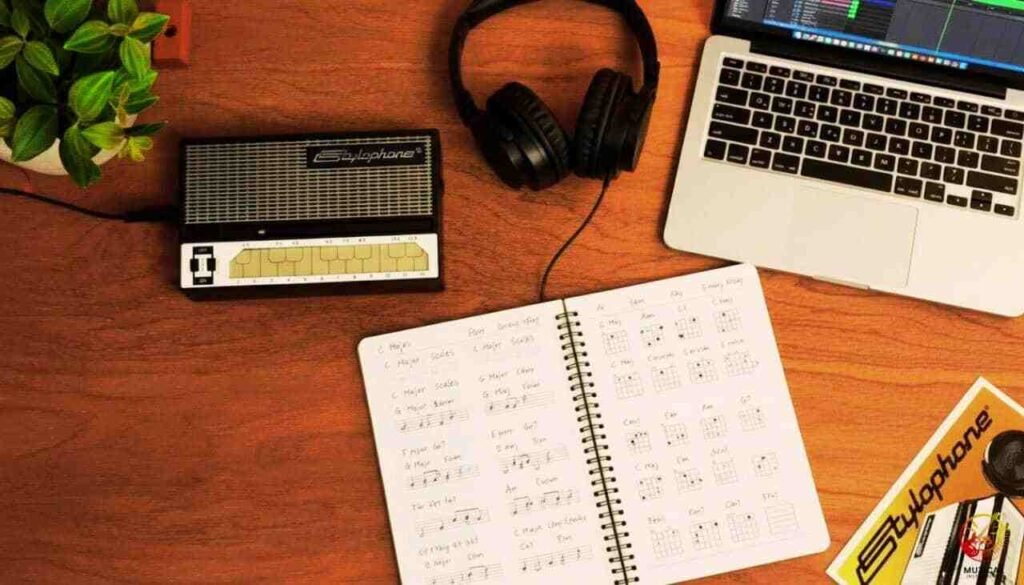
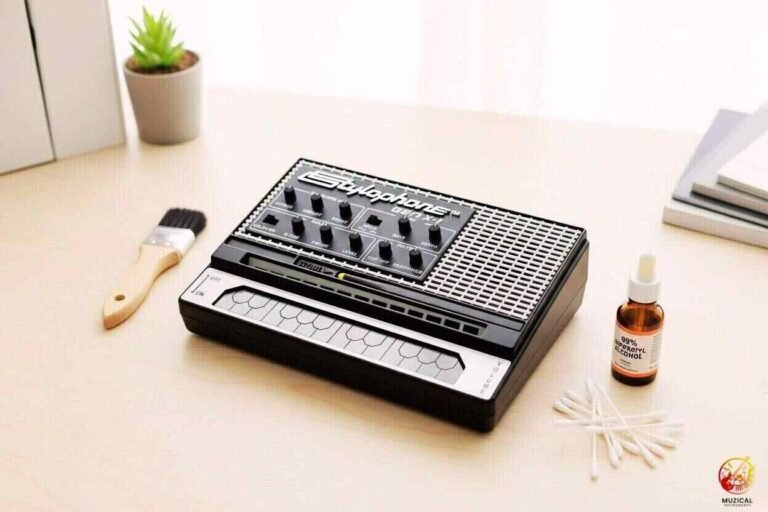
A stylophone is a small electronic instrument played with a metal pen. Each metal strip makes one clear note. It uses a piano-roll layout with a chromatic arrangement, so notes sit in order, step by step. When you use it, there is no guessing where notes are.
This solves a common problem in music theory for beginners. Many learners struggle to match symbols on paper with real sound. After using it for some time, you see how notes move step by step. That builds trust in your ear.
The limitation is clear. You cannot play full chords or complex harmony.
The practical result is strong note awareness, but limited depth.
Is A Stylophone Good For Learning Music Theory?
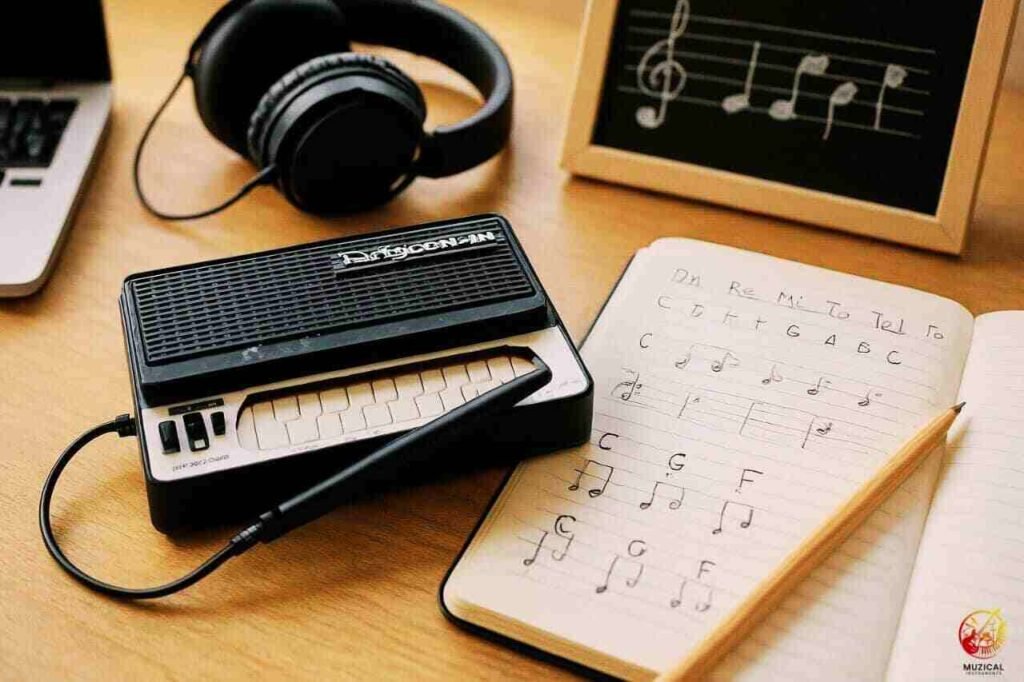
Yes, it is good for learning the basics, with a few limits.
The stylophone helps you understand core music ideas in a simple way. Its small layout makes patterns easy to see and hear.
After using it for some time, you’ll find it works well for:
- Seeing whole steps and half steps
- Learning major and minor scales
- Hearing and naming intervals
- Making simple melodies
- Understanding how notes relate
The limit is range. Most stylophones have only a few octaves. You cannot explore complex chords or rich harmony well.
This makes it best for beginners and kids. Fewer notes mean less confusion and better focus on the basics.
How Do I Read Notes On A Stylophone?
You read notes by using the two metal rows as your note guide.
The stylophone keyboard works like a small piano. The layout shows you where each note lives.
- The bottom row holds the natural notes: A, B, C, D, E, F, G
- The top row holds sharp and flat notes, like black keys on a piano
- Many stylophones print note letters above the keys to help you learn
When you play a song, you have to physically move your hand up to hit a sharp or flat. You feel the “step” up to the next note.
Over time, the letters may fade or get blocked by your hand. That is okay. Your fingers start to remember the positions. This builds strong note memory and helps you read music faster.
Can I Learn Scales On A Stylophone?
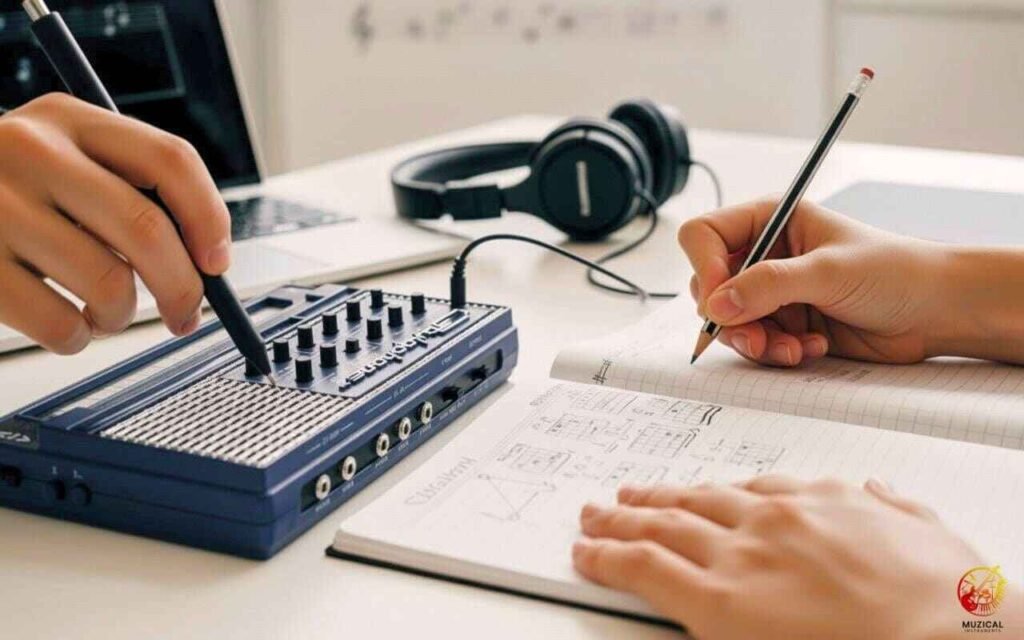
Yes, a stylophone is great for learning basic scales.
A scale is a group of notes that sound good together. The stylophone makes these patterns easy to see and feel.
- A half step is the very next key beside the one you play
- A whole step skips one key
- The keys sit close together, so the pattern is clear
To play a major scale, you follow a fixed step pattern. Your eyes and fingers learn it together.
When you slide the stylus across all the keys, you hear every note in order. This is called the chromatic scale. It helps you hear how notes rise and fall.
Most stylophones have a short range, about one and a half octaves. You reach the end quickly.
This makes the stylophone perfect for one-octave scales. It works very well for beginners and kids learning music theory.
Comparison: Stylophone vs. Piano for Theory
| Feature | Stylophone | Piano / Keyboard |
|---|---|---|
| Visual Layout | Compact, easy to see the whole octave at once | Large, can be overwhelming for new students |
| Portability | Fits in a pocket. Learn anywhere | Stationary or heavy. Hard to move |
| Note Production | Monophonic (one note at a time). Good for melody | Polyphonic (many notes). Good for harmony |
| Cost | Very cheap (usually under $40) | Expensive (hundreds or thousands of dollars) |
| Touch | Tap with a stylus. No finger strength needed | Press with fingers. Requires dexterity |
How Can Kids Learn Theory With A Stylophone?
By playing simple sounds in a fun, pressure-free way.
A stylophone looks like a toy, but it makes real notes. This makes kids feel relaxed and curious. They do not feel scared to make mistakes.
Kids do not need perfect posture or finger rules. They just hold a pen and tap. This makes starting very easy.
- The buzzing sound feels like a game
- Kids stay longer because it feels fun
- Learning happens without stress
What to watch out for
- The stylus tip is hard and pointy
- Pressing too hard can scratch the metal
- Show kids to tap gently
What kids learn naturally
- High sounds vs. low sounds
- Long sounds vs. short sounds
- How notes move up and down
15-Minute Daily Practice Routine
Here is a simple routine for how to learn music theory using a stylophone:
- Minutes 1–3 (Scales): Play a C scale up and down. Say note names
- Minutes 4–8 (Intervals): Jump between notes like C to G, then back
- Minutes 9–12(Arpeggios): Play simple chords one note at a time (C-E-G)
- Minutes 13–15 (Ear Training): Close eyes. Find a note by sound
This keeps learning fun and effective.
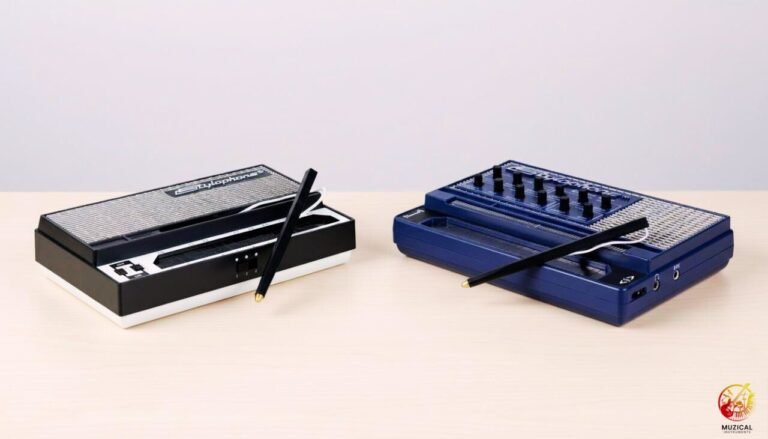
How Do Stylophone Models Compare For Music Education?
The Stylophone S1 is the best overall choice for focused music theory learning. It gives you enough octaves to learn scales, intervals, and note patterns without distractions. Other models work better for play or creativity but can limit or distract from pure theory study.
The table below shows how different stylophone models compare for music learning and theory practice.
| Model Type | Octave Range | Best For | Limitation |
|---|---|---|---|
| Original Stylophone | 1.5 octaves | Absolute beginners, young children | Very limited range restricts scale practice |
| Stylophone S1 | 3 octaves | Serious music theory study, teenagers | Higher price point |
| Stylophone Gen X-1 | 3 octaves + effects | Creative exploration, melody writing | Effects can distract from theory focus |
| Beatbox Stylophone | 2 octaves + rhythms | Rhythm and pitch combination | Beat features complicate pure theory work |
The original Stylophone costs less but has a shorter range. You cannot play full two-octave scales. This limits learning.
Still, it works well for kids under 8 or total beginners. Fewer keys feel less confusing and easier to enjoy.
Can I Use A Stylophone For Ear Training?
Yes. It helps you hear note differences and patterns clearly. The stylophone makes ear training simple and hands-on. You see the notes and hear them right away. This helps your brain link sound with position.
Easy ear training exercises you can try:
- Interval practice: Play two notes with your eyes closed. Guess how far apart they sound. Then look to check.
- Scale practice: Play a scale. Then play one note from it. Try to name its place in the scale.
- Melody copying: Listen to a short tune. Try to play it back on the stylophone.
- Pattern repeat: Play a short note pattern. Move it higher or lower and play it again.
With daily practice, you stop guessing notes. You start hearing how notes relate to each other.
One tip: the stylophone has one sound. Also sing the notes or listen to other instruments. This helps your ear learn sounds, not just one tone.
What Basic Music Theory Should I Learn Using A Stylophone?
You should learn note order, scales, and simple chords first. Begin with the chromatic scale. This means playing every key in order. Each step you hear is a half step. This is the smallest move in music.
Learn these ideas in this order:
- Note names and places: Know where each note sits on the keyboard
- Half steps and whole steps: One key apart or skipping one key
- Major scales: Happy-sounding note patterns
- Minor scales: Sad or calm-sounding patterns
- Intervals: How far one note is from another
- Broken Chords/Arpeggios: Notes of a chord played in sequence
- Key basics: Why some songs use sharps or flats
- Simple melodies: Make short tunes using what you learned
Follow this order. Each step builds on the last one. The stylophone shows mistakes fast, so you learn the right way. After this, you can use the same theory on any instrument.
Should I Use A Stylophone As My Only Music Theory Tool?
No. It works best when you use it with other learning tools. A stylophone helps you see and feel music ideas. It turns hard ideas into simple actions. But it cannot teach everything by itself.
Use it together with:
- Theory books: Writing notes helps ideas stay in your mind
- Music apps: Apps give games and quizzes the stylophone cannot
- Ear training tools: These train your listening step by step
- Another instrument or singing: This adds real music depth
- Sheet music practice: Reading notes connects sound to symbols
The stylophone is a bridge. It connects thinking about music to playing music. It is small, clear, and fun. But it has limits in sound range and power.
For beginners ages 8–14, it is a great start. For older or advanced learners, it works best as a helpful extra tool.
Stylophone For Learning Music Theory: Final Takeaway
The stylophone helps you see and feel music theory. You touch the notes and hear how they work together. It does not replace books or full instruments, but it makes the basics easy to understand. This is great when you are just starting or teaching a child.
Choose a stylophone if you want hands-on learning, clear note patterns, and practice anywhere. Skip it if you need big chords, deep theory, or already use a piano or keyboard every day.
FAQ: Stylophone for Learning Music Theory
1. Is the stylophone easy to learn for beginners?
Yes, it is one of the easiest instruments to start with. You do not need strong fingers or special hand positions like a guitar or piano. You just hold the stylus and tap the metal keys to make sound. Most people can play a simple melody within 10 minutes.
2. Do I need to read sheet music to play the stylophone?
No, you do not need to read traditional music notation. Most stylophones have numbers printed above the keys, usually from 1 to 20. Many song guides use these numbers instead of notes, so you can play songs by following simple number patterns.
3. Can I play chords on a standard stylophone?
No, most standard stylophones are monophonic, meaning they play only one note at a time. Touching two keys usually causes a glitchy sound or plays just one note. To copy a chord, you must play the notes very quickly one after another.
4. Is the stylophone just a toy or a real instrument?
It is both. It was first sold as a toy in the 1960s, but musicians like David Bowie and bands like Kraftwerk used it in famous songs. It is great for learning music and is also used by professionals for its unique electronic sound.
5. What songs can I play on a stylophone as a beginner?
You can play any simple melody that does not need chords. Good beginner choices include “Happy Birthday,” “Twinkle Twinkle Little Star,” or the bass line from “Seven Nation Army.” Since the keys follow a piano layout, easy piano melodies work well too.