
Unpacking the Difference Between Piano and Button Accordion

The difference between piano and button accordion shows up the moment you touch them. One uses piano-style keys. The other uses small round buttons.
A piano accordion gives you a straight, left-to-right layout like a piano. Notes feel easy to find. A button accordion uses tight button patterns. Your fingers move less, but your brain works more at first.
You will notice three clear differences right away. The layout is different. The hand movement is different. The learning curve is different. These small changes decide which one feels right for you.
Piano Accordion vs. Button Accordion Comparison
This matrix highlights the practical realities to help you decide which instrument fits your physical needs and musical ambitions.
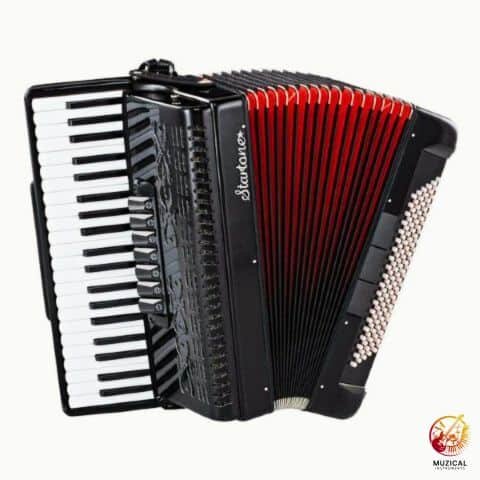
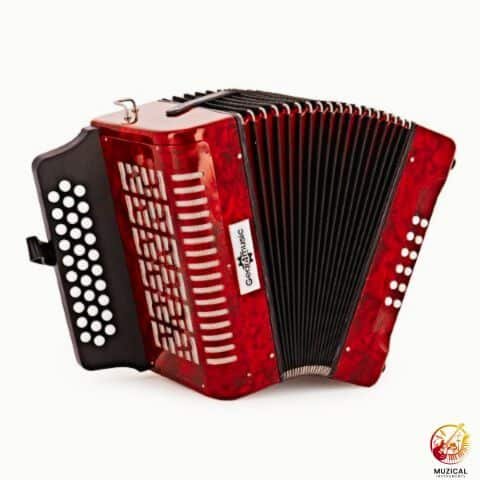
| Feature | Piano Accordion (PA) | Chromatic Button Accordion (CBA) |
|---|---|---|
| Right-Hand Interface | Vertical piano-style keys | Honeycomb grid of small round buttons |
| Learning Curve | Fast start (especially with prior piano experience) | Steep initial curve; requires “blind” tactile navigation |
| Finger Reach | Limited; reaching wide chords is difficult for small hands | Superior; tiny buttons allow for a massive 2.5-octave reach |
| Transposing Keys | Difficult; every musical key requires a new fingering pattern | Effortless; one physical shape works for every musical key |
| Size & Weight | Taller and bulkier due to the long wooden keyboard frame | Highly compact; fits a larger note range into a smaller body |
| Primary Repertoire | Jazz, Pop, Western Classical, and standard Folk | French Musette, Russian Folk, Balkan, and complex Classical |
What Is The Difference Between Piano And Button Accordion?

The primary difference is the right-hand interface.
A Piano Accordion uses a standard piano keyboard, making it intuitive but physically limiting your hand’s reach.
A Chromatic Button Accordion uses a compact honeycomb grid, allowing players to reach 2.5 octaves with a single hand spread and transpose musical keys without ever changing their fingering patterns.
A Quick Note on “Button” Accordions
Before comparing them to a piano accordion, you must understand that “Button Accordions” are actually two completely different instruments:
- Diatonic: Used primarily for traditional folk music (like Irish or Norteño). They are bisonoric, meaning they play a different note depending on whether you are pushing or pulling the bellows (like a harmonica).
- Chromatic (CBA): Used for classical, jazz, and musette. They are unisonoric, playing the same note regardless of bellows direction. In this guide, when we compare buttons to the piano accordion, we are exclusively discussing the Chromatic Button Accordion.
How Your Hand Moves: Reach and Speed
The most significant physical difference is how much of the instrument your hand can cover at one time.
- The Piano Limitation: On a piano accordion, the keys are long and wide. If you have average-sized hands, reaching an octave is comfortable, but jumping further is a physical strain. Furthermore, the entire instrument must be built tall and heavy to accommodate the keyboard.
- The Button Advantage: On a button accordion, the buttons are tiny and tightly clustered. This allows you to reach a massive range of notes, about two and a half octaves, without shifting your wrist. This ergonomic advantage makes rapid arpeggios and complex, high-speed phrasing significantly easier.
Learning to “See” with Your Fingers
- The Piano Map: Playing a piano accordion is visually intuitive. The black keys are grouped in twos and threes. Even if you aren’t looking down, your fingers can feel the gaps between the black keys to anchor your hand position.
- The Button Sea: A button accordion presents a uniform sea of 60 or more identical buttons, which can be intimidating. To play without looking, you must learn to navigate by touch, feeling for specific “Marker Buttons.” These are textured or cross-hatched buttons (usually C and F) that act as physical anchors for your hand.
The “Transposing” Superpower
- On a Piano Accordion: If you learn a song in C Major and need to play it a half-step higher in C# Major, you must learn an entirely new sequence of black and white keys.
- On a Button Accordion: Because the buttons are laid out in a geometric grid, the physical “shape” of a scale or chord never changes. To transpose a song higher, you simply slide your hand down one row and execute the exact same finger movements.
Is A Piano Accordion Or Button Accordion Easier For Beginners?
If you have prior keyboard experience, the Piano Accordion is significantly easier for the first 3 months. However, the Chromatic Button Accordion (CBA) is ergonomically superior in the long run. Crucially, this difficulty only applies to your right hand. The left-hand bass board is completely identical on both instruments.


The Left Hand is the Same!
A major source of anxiety for beginners is the left-hand button board. Fortunately, both the Piano Accordion and the Chromatic Button Accordion use the exact same Stradella Bass System (usually 72, 96, or 120 buttons). Your choice of instrument only affects what your right hand is doing.
Piano Accordion: The Fast Start
For many learners, particularly those with basic piano knowledge, the piano accordion offers a highly rewarding entry point. You recognize the layout instantly, and simple melodies come together on day one.
- The Trade-Off: As your repertoire grows more complex, the piano keyboard becomes a physical liability. Making wide, vertical jumps across the keys while simultaneously pulling a heavy bellows in and out can lead to messy, inaccurate playing at high speeds.
Button Accordion: The “30-Day Wall”
The Chromatic Button Accordion requires immense patience upfront.
- The Reality: For the first month, progress is remarkably slow. Without the visual guide of black and white keys, your brain must learn to navigate a uniform grid entirely by touch.
- The Payoff: Once your muscle memory maps the grid, a massive shift occurs. Because the buttons are so compact, your hand rarely has to stretch or jump. You simply wiggle your fingers in one place to play lightning-fast runs that would exhaust a piano accordionist.
Which Accordion Type Sounds Better?
The sound of an accordion is not determined by whether it has keys or buttons. Tone is entirely dictated by the internal reed blocks, specifically the “Tuning Style” (Wet vs. Dry) and whether the instrument features a resonant Tone Chamber (Cassotto).
Wet vs. Dry Tuning
- Wet (Musette) Tuning: The manufacturer tunes two reeds slightly out of sync with each other. This creates a vibrating, shimmering tremolo effect synonymous with French café music and traditional folk styles.
- Dry Tuning: The reeds are tuned perfectly in unison. The resulting tone is straight, clean, and piercing, ideal for American Jazz, Pop, and Classical music. Both Piano and Button accordions can be ordered with either tuning.
The Tone Chamber (Cassotto)
If you want an incredibly warm, dark, and smooth tone, look for an instrument with a Cassotto. Instead of sound projecting straight out of the grill, the air is routed through a wooden chamber that softens harsh high frequencies.
- The Catch: While both instrument types can feature a Cassotto, the solid wood chamber adds significant weight and cost. It is not recommended if you need a lightweight travel instrument.
How Do I Choose The Right Accordion For My Child?
To choose the right accordion for a child, you must prioritize weight and physical frame. For children under 10, a compact 48-bass or 72-bass accordion is mandatory. Never buy a full-sized 120-bass instrument for a child, as the 20+ pound weight will cause back pain and inevitable frustration.
The 120-Bass Mistake
It is incredibly tempting to buy a full-size 120-bass accordion for a child because used models are cheap and plentiful. Do not do this. A 120-bass instrument is massive. On a small child, the top of the keyboard will dig into their chin, and the bottom will rest awkwardly on their knees. They will lack the leverage to properly control the bellows, leading to rapid fatigue and a desire to quit. Stick to lighter 48-bass or 72-bass models (usually 10 to 14 pounds) that fit their physical frame.
The Local Teacher Reality
While a compact button accordion is ergonomically fantastic for small hands, it poses a logistical problem. In places like the US, UK, and Australia, it is incredibly easy to find a piano teacher willing to help your child with the right-hand piano accordion melodies. Finding an in-person Chromatic Button Accordion teacher in those same regions is exceedingly rare. If you cannot find a local instructor, the Piano Accordion is the safer educational choice.
Final Thoughts: The Decision Matrix
Choose the Piano Accordion If:
- You already play the piano, synth, or keyboard.
- You want to play Pop, Jazz, or recognizable modern hits quickly.
- You live in North America or the UK and need to find a local teacher easily.
- You don’t mind a slightly taller, heavier instrument.
Avoid the Piano Accordion If:
- You have small hands and struggle to reach wide musical octaves.
- You travel constantly and need the most compact instrument possible.
Choose the Button Accordion If:
- You have absolutely no prior piano experience and want a fresh start.
- You want to play high-speed French Musette, Balkan, or complex Classical music.
- You want the ability to easily transpose songs into any musical key.
- You are patient enough to survive a slow, frustrating first 30 days of practice.
Avoid the Button Accordion If:
- You want instant gratification and an intuitive visual layout.
- You are on a tight budget (cheap, used student CBAs are hard to find outside of Europe).
FAQ: Difference Between Piano and Button Accordion
1. Is a button accordion harder to learn than a piano accordion?
It depends on your musical background! If you already play the piano, the piano accordion feels much easier at first. However, if you are starting from scratch, the button accordion is actually better for your hands in the long run.
2. Do piano and button accordions sound different?
No, the keys and buttons do not change the sound. The tone comes from the metal reeds inside the instrument. Both types can be tuned to sound wet and shimmering for folk music, or dry and clean for jazz.
3. Why are button accordions so much smaller?
Buttons take up much less room than long piano keys. Because the buttons are tiny and packed into a tight grid, accordion builders can fit a huge range of notes into a very compact and lightweight frame.
4. Are the left-hand buttons the same on both accordions?
Yes, they are! Both the piano and chromatic button accordion use the exact same Stradella bass system on the left side. You only have to decide what you want your right hand to do.
5. Can a beginner start on a chromatic button accordion?
Absolutely! Many teachers actually prefer it for complete beginners. You will bypass bad piano habits and learn a brilliantly fast, ergonomic system from day one. Just be patient during your first few weeks of practice!


