
Benefits of Playing Accordion for Kids: How This Instrument Helps Your Child Grow

Playing the accordion uses many parts of the brain at the same time. It makes the hands, arms, and mind work together. That is why it is such a powerful first instrument for kids and one of the key benefits of playing accordion for kids.
The benefits of playing accordion for kids go beyond making music. It helps your child focus better, remember more, and feel proud of learning something new. These skills also help at school and with friends.
In this article, you will learn:
- How the accordion improves brain power and multitasking.
- Why the physical action of the bellows teaches emotional control.
- The social advantages of playing a unique instrument.
- Practical tips for getting started.
Does Playing Accordion Improve Hand-Eye Coordination In Kids?
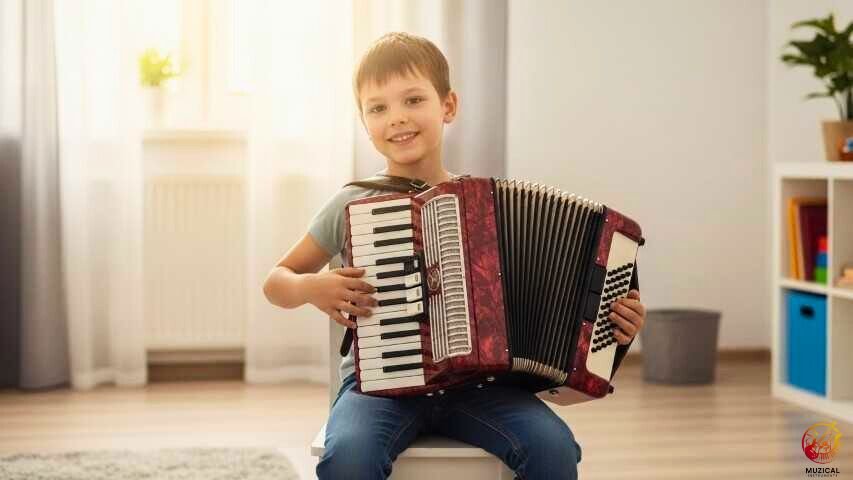
Most instruments require hands to work together. The accordion requires them to work independently while the arms control the air. This is a massive leap for child development.
On a piano, both hands are in front of you. On an accordion, the right hand plays keys (like a piano), the left hand pushes buttons you cannot see, and the left arm pushes and pulls the Bellows to make sound.
This forces the brain to build new pathways. It creates a high level of accordion and hand coordination that improves a child’s reaction time and physical dexterity, a core developmental benefit of playing accordion for kids.
How Does The “Blind” Left Hand Work?
One of the coolest skills a child learns is navigating the bass buttons by touch alone. The left hand must find the correct buttons without looking. This improves tactile sensory awareness, the ability to “see” with their fingers. It turns music practice into a fun, tactile game of hide and seek for their fingers.
How Does Accordion Help Brain Development In Kids?
When we talk about how accordion helps brain development, we are talking about “multitasking” in its truest form.
To play a song, a child must:
- Read the melody notes (Treble clef).
- Read the bass chords (Bass clef).
- Physically pump the bellows to control volume and phrasing.
- Listen to the output to stay on beat.
This intense mental processing strengthens the corpus callosum, the bridge between the left and right sides of the brain. Studies suggest this kind of musical training helps kids process information faster, which supports math and reading skills.
What Are The Physical Benefits Of Playing Accordion For Kids?
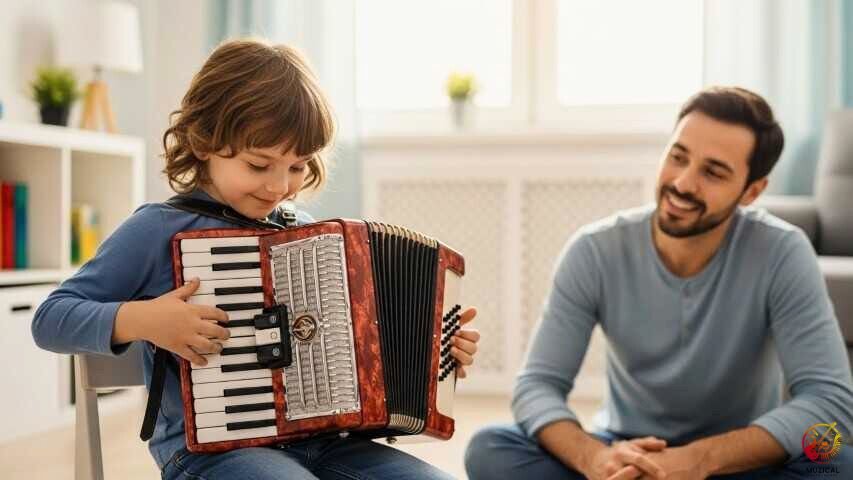
This is a benefit you won’t find in piano or guitar lessons. The accordion is a wind instrument. It needs air to speak.
The player controls the “lungs” of the instrument with their left arm. To play a smooth phrase, a child has to pull the bellows smoothly. To play a sharp, rhythmic beat, they have to snap the bellows quickly.
This teaches children emotional regulation and phrasing. They learn that music isn’t just pushing buttons; it’s about breathing life into sound. This physical connection to the sound is deeply satisfying and helps children express emotions they might not have words for.
These physical benefits show how playing accordion supports full-body development in kids, not just finger movement.
| Physical Benefit | How Accordion Helps | Real-World Application |
|---|---|---|
| Hand Coordination | Independent finger movements on both hands | Better typing, writing, sports activities |
| Core Strength | Maintaining posture while holding instrument | Improved athletic performance, less back pain |
| Breath Control | Managing bellows for tone and volume | Enhanced stamina in physical activities |
| Fine Motor Skills | Precise button/key pressing | Improved dexterity for detailed tasks |
Is The Accordion A Good Instrument For Building Confidence In Kids?
Let’s be honest: there are a lot of kids playing piano and violin. There are very few playing the accordion.
When a child brings an accordion to show and tell, they are instantly the center of attention. It is a loud, happy, and fascinating machine. Mastering such a complex-looking instrument gives children a sense of pride. They aren’t just following the crowd; they are doing something unique.
This connects to social skills. The accordion is a “social instrument.” It is portable (unlike a piano) and loud enough to lead a sing along (unlike a guitar). It encourages kids to perform for family and friends, breaking down stage fright early on.
For kids who struggle to stand out or speak up, this makes the accordion one of the best confidence building instruments available.
Comparison: How Does Accordion Compare To Piano Or Guitar?
Here is how the accordion stacks up against other popular choices for kids. When parents compare instruments, this breakdown shows why accordion offers a wider range of developmental benefits for kids.
| Feature | Piano | Guitar | Accordion |
|---|---|---|---|
| Physical Challenge | Low (Sit and play) | Medium (Finger pain on strings) | High (Weight + Bellows control) |
| Portability | None (Stays in one room) | High (Easy to carry) | Medium (Portable but heavy) |
| Brain Challenge | High (Two hands) | Medium (Two hands) | Very High (Two hands + Bellows) |
| Tuning Required | Yes (Professional needed) | Yes (Daily by student) | No (Reeds stay in tune) |
| Social Factor | Solo or Accompaniment | Campfire/Band | Party/Folk Leader |
Does Playing Accordion Improve Concentration In Children?
Learning accordion benefits for children includes a lesson in patience. Because the instrument has so many parts (keys, buttons, switches, bellows), you cannot rush it.
A child cannot just “mash” the keys like they might on a toy keyboard. If they don’t move the bellows, no sound comes out. This immediate feedback loop teaches cause and effect. They learn that to get the result they want, they must coordinate all their actions perfectly. This builds deep concentration and focus skills that translate to better attention spans in the classroom.
This is why improved focus is one of the most practical benefits of playing accordion for kids, both in music practice and in school.
What Social Benefits Do Kids Gain From Learning Accordion?
Accordion isn’t a solo only instrument. Kids can join folk bands, polka groups, classical ensembles, or contemporary music projects. This opens social opportunities that build confidence.
Playing in groups teaches several life skills:
Active Listening
Your child must hear other musicians while playing their own part. This develops empathy and awareness of others.
Collaboration
Band practice requires compromise and teamwork. Kids learn when to lead and when to support.
Cultural Awareness
Accordion appears in Irish, French, German, Mexican, and Cajun music traditions. Learning these styles exposes kids to different cultures naturally.
Performance Confidence
Regular recitals help kids overcome stage fright. This confidence transfers to school presentations and social situations.
Does The Accordion Make Music Theory Easier For Kids?
The left hand of the accordion (the Stradella Bass System) is a layout of music theory logic.
- Buttons are arranged by the “Circle of Fifths” (a core music concept).
- One button plays a single note, and the button next to it plays a full chord.
By simply pressing buttons, a child learns how harmony works. They hear how a “C” note matches with a “C Major” chord. They don’t just read theory in a book; they feel it under their fingers. This makes music learning benefits for kids much faster on accordion than on instruments where you have to build chords manually note-by-note.
Does Playing Accordion Help Kids Perform Better At School?
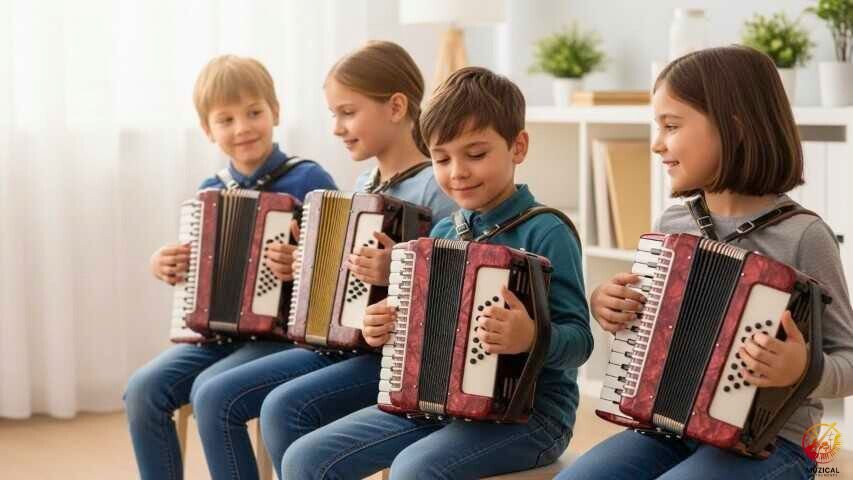
Many parents ask if music lessons actually help at school. For kids learning accordion, the answer is often yes.
The connection between accordion and academics is stronger than you might expect. The pattern recognition skills from reading music transfer directly to math and reading comprehension.
When your child reads accordion music, they’re decoding symbols, patterns, and rhythms simultaneously. This multi-layered processing strengthens the same brain regions used for:
- Algebraic thinking
- Reading comprehension
- Problem-solving sequences
- Time management
A 2019 study in the Journal of Educational Psychology tracked 200 students over four years. Those with musical training, particularly on complex instruments like accordion, showed 15% higher grades in math and science courses.
The discipline required for daily practice also teaches time management. Kids learn to break big goals (mastering a piece) into small steps (practicing sections). This skill becomes automatic and helps with homework planning and project management.
What Are The Learning Milestones For Kids Playing Accordion?
Here is a realistic timeline of what your child will learn in their first year.
| Timeline | Skills Learned | Brain Benefit |
|---|---|---|
| Month 1–3 | Holding the instrument, simple right-hand melodies, “breathing” with bellows. | Motor Skills: Posture and arm strength. |
| Month 4–6 | Adding left-hand bass notes. Coordinating hands together slowly. | Focus: Splitting attention between two tasks. |
| Month 7–12 | Playing songs with rhythm. Navigating buttons without looking. | Memory: Muscle memory and tactile sensory skills. |
Are There Any Challenges Parents Should Know About?
Accordion isn’t the easiest instrument to start. The initial learning curve is steeper than keyboard or guitar. Your child might feel frustrated in the first few months.
Common Challenges
- The weight takes getting used to. Young kids tire quickly at first. Short, frequent practice sessions work better than long ones.
- Finding qualified teachers can be difficult. Accordion isn’t as popular as piano or guitar, so specialists might be limited in your area. Online lessons have made this easier recently.
- The cost ranges from $300 for beginner models to $2,000+ for quality instruments. However, good used accordions hold value well and can be resold.
- Noise might be an issue in apartments. Unlike electric instruments, you can’t use headphones. Practice times need coordination with neighbors and family.
Solutions That Work
- Start with 10-minute practice sessions and gradually increase. Let your child build endurance naturally.
- Connect with accordion associations. Groups like the Accordion Teachers Guild of America offer teacher directories and online resources.
- Rent before buying. Many music stores offer rent-to-own programs. This lets your child try the instrument before committing.
- Use practice mutes. These dampen the sound by about 30% without affecting the playing technique.
Knowing these challenges helps parents decide if the accordion is the right instrument for their child.
Final Thoughts
The benefits of playing accordion for kids are clear. It builds a stronger brain, better coordination, and real confidence through hands-on learning.
By playing the accordion, your child becomes an active creator who learns to manage melody, rhythm, and emotion at the same time. That combination makes accordion not just fun, but one of the most complete developmental instruments for children.
FAQ: Benefits Of Playing Accordion For Kids
1. What is the best age for a child to start accordion?
Most teachers say 6 or 7 years old is the perfect time to start. At this age, children are usually strong enough to hold a small “student model” accordion comfortably. If a child is too small, the instrument might feel too heavy, which can make practicing hard.
2. Is accordion difficult for kids to learn?
It has a small learning curve, but it is very fun. The hardest part at first is squeezing the bellows (the air pump) while playing the keys. However, the buttons on the left hand are designed to make playing chords very easy. Once a child gets the rhythm, they can play full songs faster than on many other instruments.
3. Does playing accordion make you smarter?
Yes, it really gives the brain a workout! Because a child must use their right hand, left hand, and left arm all at the same time, it builds strong connections in the brain. This “multitasking” helps improve memory, coordination, and focus skills that are useful in school.
4. Should my child learn piano before accordion?
You do not need to learn piano first. While piano helps with learning the keys, the accordion is its own unique instrument. You can start straight on the accordion. It teaches you everything you need to know about melody, harmony, and rhythm all in one package.
5. How do I choose the right size accordion for my child?
Fit is very important. For very young kids (ages 4–6), look for a “12-bass” accordion. For most beginners (ages 6–10), a “48-bass” model is the best choice. It is small enough to handle but has enough notes to play many songs. Avoid buying “toy” accordions; a real student instrument sounds much better and is easier to play.


