How a Piano Practice Mute Helps You Play Without Noise

A piano practice mute reduces the volume of your piano by 40-90%, letting you practice at any hour without disturbing neighbors or family. This simple device sits between the hammers and strings, dampening the sound while keeping the natural feel of your keyboard.
In this article you’ll learn how a piano practice mute helps you play quietly, how these mute systems work, which type fits your piano, and how to install one yourself.
What Is A Piano Practice Mute And How Does It Work?

A piano practice mute is a physical barrier that stops piano hammers from hitting the strings with full force. Think of it like putting a pillow between a drumstick and a drum.
When you press a piano key, a hammer strikes the strings inside your piano. A mute intercepts this action. It creates a buffer that reduces the impact force and absorbs most of the sound vibrations.
Most mute systems use a long felt rail that drops down in front of all the strings at once. You activate it with a pedal or lever. The hammers still move. They still hit something. But the sound comes out much quieter.
The mechanism varies between upright pianos and grand pianos because their internal structures differ completely.
How A Piano Practice Mute Helps You Play At Home Without Noise?
A mute reduces the loudness by lowering the hammer impact. Most upright piano mutes cut the sound level by 40–80%, depending on the model. That difference lets you practice:
- early morning
- late at night
- during a child’s nap
- in shared buildings
- in student dorms
When you use a mute, you stay in control of your sound. You do not disturb neighbors. You do not wake anyone. And you avoid noise complaints.
This is the part many articles skip: real-world peace matters more than technical details. A mute lets you protect your relationships while still building your skill.
What Are The Main Types Of Piano Mute Systems?
Different piano designs need different muting approaches. Here’s what works for each type:
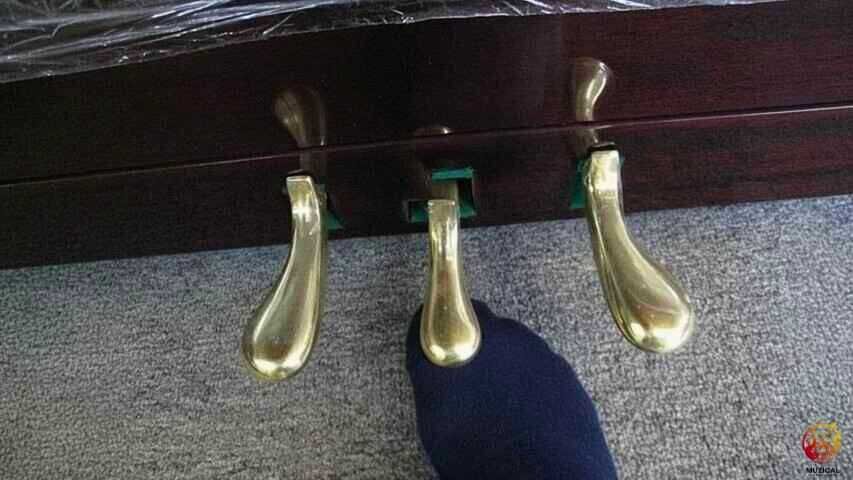

Built-in Practice Pedals
Many modern upright pianos come with a middle pedal called a practice pedal. When you push it down and lock it in place, a felt strip lowers between the hammers and strings. This cuts your piano volume by about 50%.
Some digital pianos and hybrid acoustic-digital models offer even more control. They can reduce volume up to 90% and let you adjust the level.
Aftermarket Mute Rails
Older pianos without a practice pedal can get an aftermarket mute rail installed. A piano technician mounts a felt rail system inside your piano. You control it with a newly installed pedal or a hand lever.
This works for both upright pianos and some grand pianos, though installation is more complex on grands.
Grand Piano Mute Systems
Grand pianos pose a bigger challenge. Their horizontal design makes drop-down rails less practical. Some manufacturers offer special mute systems designed specifically for grands. These typically involve a felt rail that slides into position above the strings.
Professional concert halls sometimes use mechanical systems that lower all the hammers closer to the strings, reducing travel distance and impact force.
| Piano Type | Mute Method | Volume Reduction | Installation Difficulty |
|---|---|---|---|
| Upright (built-in pedal) | Felt rail activated by middle pedal | 40–60% | Already installed |
| Upright (aftermarket) | Mounted felt rail with new pedal/lever | 50–70% | Moderate (needs technician) |
| Grand piano | Sliding felt rail or hammer adjustment | 30–50% | Complex (professional required) |
| Digital/Hybrid | Electronic volume control | Up to 90% | Simple (volume knob) |
How Do I Install A Piano Mute System?
Installation depends entirely on whether you’re working with built-in hardware or adding new equipment.
Using a Built-in Practice Pedal
If your upright piano has three pedals, the middle one is likely your practice pedal. Press it down while playing and see if the sound drops noticeably. Some pedals lock in place when you push them to the left. Others stay down only while you hold them.
No installation required here. Just use it.
Adding an Aftermarket Mute Rail
This requires a qualified piano technician. The process takes 1-3 hours and involves:
- Removing the front panel of your upright piano
- Mounting brackets inside the piano frame
- Installing the felt rail mechanism
- Connecting it to a new pedal or installing a hand lever
- Adjusting the rail position for proper contact
The cost typically ranges from $200 to $500, depending on your location and the complexity of your piano model.
Silent Piano Systems
Some pianists prefer silent piano systems over simple mutes. These sophisticated systems stop the hammers before they hit the strings at all. Optical sensors detect your key presses and generate sound through headphones or speakers instead.
Yamaha and Kawai both manufacture pianos with built-in silent systems. You can also retrofit these systems into existing acoustic pianos, though it costs $2,000 to $4,000 for professional installation.
What Are The Pros And Cons Of Using A Piano Practice Mute?
Every practice solution involves tradeoffs. Here’s what you gain and lose with piano mutes:
Pros
- Practice whenever you want without guilt
- Keep neighbors and family members happy
- Maintain your acoustic piano experience
- Much cheaper than buying a second digital piano
- No need for headphones or electronic equipment
- Touch and key weight feel exactly like unmuted playing
Cons
- Tone quality suffers significantly
- You can’t hear subtle dynamics and expressions
- Missing the full resonance affects your musical development
- Some techniques sound completely different when muted
- Pedal work becomes hard to evaluate properly
- Bass notes still create some floor vibration
Most piano teachers recommend mixing muted and unmuted practice sessions. Use the mute when you need to be quiet. But also schedule regular practice time at normal volume so you develop proper tone production skills.
| Feature | With Mute | Without Mute |
|---|---|---|
| Volume level | 40–70% quieter | Full acoustic sound |
| Tone quality | Muffled, compressed | Rich, resonant |
| Touch response | Identical | Identical |
| Dynamic range | Limited | Full expression |
| Neighbor impact | Minimal | Significant |
| Musical development | Good for mechanics | Essential for artistry |
How Do You Maintain Piano Sound Quality While Practicing Quietly?

Muted practice helps you work on technical skills without disturbing others. But you can’t develop musical artistry when you can’t hear proper tone.
Balance Your Practice Routine
- Spend 30-40% of practice time with the mute engaged
- Use this time for scales, arpeggios, and repetitive exercises
- Reserve musical pieces for unmuted practice sessions
- Schedule at least three unmuted sessions per week
- Record yourself playing without the mute to track progress
Focus on Technical Elements During Muted Practice
When practicing with reduced volume, concentrate on:
- Finger placement accuracy
- Hand position and posture
- Reading sheet music fluently
- Memorizing difficult passages
- Building muscle memory through repetition
Save your work on dynamics, pedaling, and tone production for times when you can play at full volume.
Final Thoughts
A piano practice mute is a simple, effective tool that uses felt to lower the volume of your acoustic piano. It is perfect for late-night practice or apartment living. While it doesn’t make the piano 100% silent like a digital system, it reduces the noise enough to keep neighbors happy without changing the weight of your keys.
Check your piano’s middle pedal right now. If it locks into place when you slide it to the left, you already have a mute system! If not, contact a local piano tuner and ask for a quote to install a “manual mute rail” for your specific model.
FAQ: How a Piano Practice Mute Helps You Play Without Noise
1. What does the middle pedal on a piano actually do?
On most home pianos (uprights), the middle pedal is the “practice mute.” When you press it down and slide it to the left, it drops a piece of felt between the hammers and strings. This makes the piano much quieter. On large concert pianos (grands), this pedal usually holds notes out longer instead of muting them.
2. Can I add a mute to my piano if it doesn’t have one?
Yes, you can. A piano technician can install a “mute rail” inside most upright pianos. It costs a few hundred dollars. If you don’t want to install anything, you can buy thick sound cups to put under the piano wheels, which stops sound from going through the floor.
3. Does using the practice pedal damage the piano?
No, it is safe for your instrument. The felt actually pads the hammers, so they don’t hit the steel strings as hard. However, the felt strip itself can get worn out if you use it every single day. You might need to replace the felt strip after a few years, but your piano will be fine.
4. How loud is a piano with the mute pedal on?
It is about as loud as a normal conversation. Without the mute, a piano is as loud as a vacuum cleaner. With the mute on, people in the next room might hear a dull thumping sound, but they won’t hear loud music. It is usually quiet enough for apartment living.
5. Is it better to use a practice mute or a digital keyboard?
It depends on your goal. A practice mute lets you keep the feel of real keys, but the sound is muffled and fuzzy. A digital keyboard with headphones gives you perfect sound, but the keys feel different than a real acoustic piano. Most students prefer the mute rail because it builds stronger finger muscles.