Do Bronze Strings Work on Old Mandolins? A Complete Guide

Old mandolins often have soft wood, light bracing, and fragile tops. So, do bronze strings work on old mandolins? The simple answer is yes, they can. But… and this is a very big “but”, it all depends on the string’s tension, not just the fact that they are bronze.
Putting the wrong strings on a vintage mandolin can cause serious, expensive damage.
This guide will help you understand what to look for. You will learn the safe way to choose strings, what “bronze” really means, and how to protect your old instrument.
What Is The Biggest Danger Of Using New Strings On An Old Mandolin?
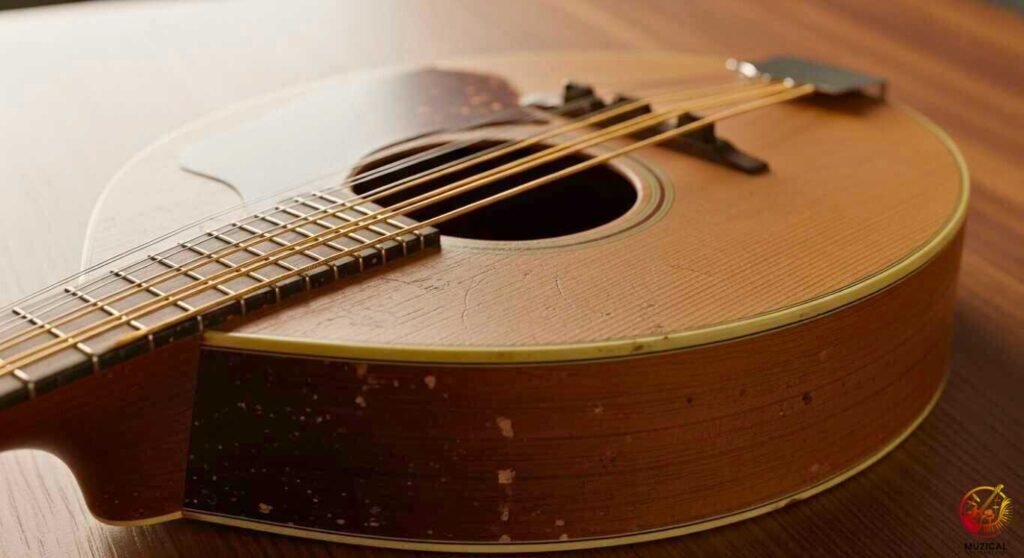
The single biggest danger is string tension.
Think of tension as the total pulling force of all eight strings. They are constantly pulling on the mandolin’s neck and top (the soundboard). Modern mandolins are built to handle a lot of force. But many old instruments, especially those made before the 1930s, are built much more lightly.
A set of modern, medium gauge bronze strings can have over 180 pounds of tension. An old, fragile mandolin might only be built to handle 150 pounds or less.
Putting high tension strings on a lightly built instrument is like putting a truck engine in a small rowboat. The boat will simply tear itself apart.
What Are The Warning Signs Of Too Much String Tension?
How do you know if the strings on your mandolin are too heavy? Your instrument will show you signs of stress.
Look for these problems:
- A Sinking Top: The top of the mandolin, right under the bridge, starts to dip or “sag” inward.
- A Bending Neck: The neck starts to bow forward (called “excess neck relief“), making the strings high and hard to play.
- A Lifting Bridge: The bridge starts to tilt forward toward the neck.
- Cracks in the Wood: You might see small cracks forming near the bridge or soundholes.
- Braces Breaking: Inside the mandolin, small wooden beams called braces can pop loose or crack. You might hear a buzzing sound if this happens.
If you see any of these signs, loosen the strings immediately and take your mandolin to a luthier (an expert stringed-instrument repair person).
Are All “Old” Mandolins The Same? (Bowl-back vs. Arch-top)
No. This is the most common mistake people make. “Old” can mean two very different types of mandolins, and they must be treated differently.
Bowl-Back Mandolins (or “Tater Bugs”)
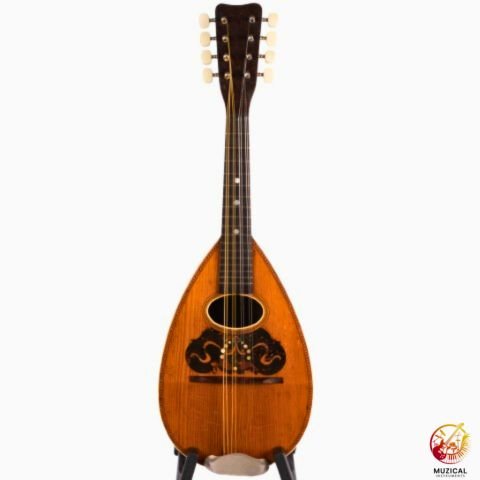
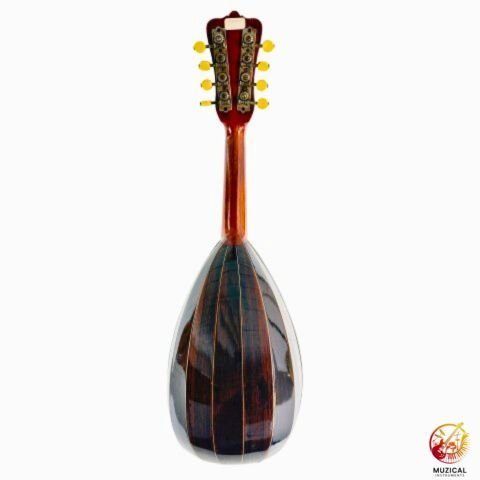
- What they are: These are the classic “tater bug” mandolins you see in old pictures, with a deep, round back made of several wood strips.
- The Danger: They were made in the 1890s to 1920s and are extremely fragile. They were designed for very light strings, much lighter than anything used today.
- The Rule: You should never put standard bronze mandolin strings on a bowl-back mandolin. You risk completely destroying it. They need special, ultra-light, low-tension strings.
Vintage Arch-Top Mandolins (Gibson A-style and F-style)
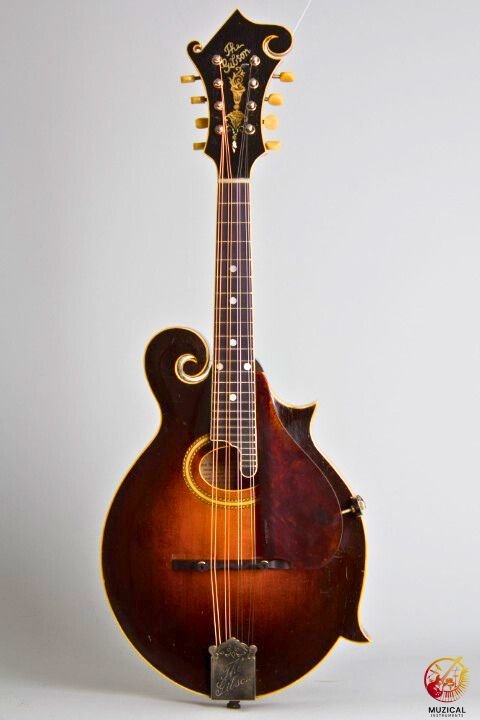
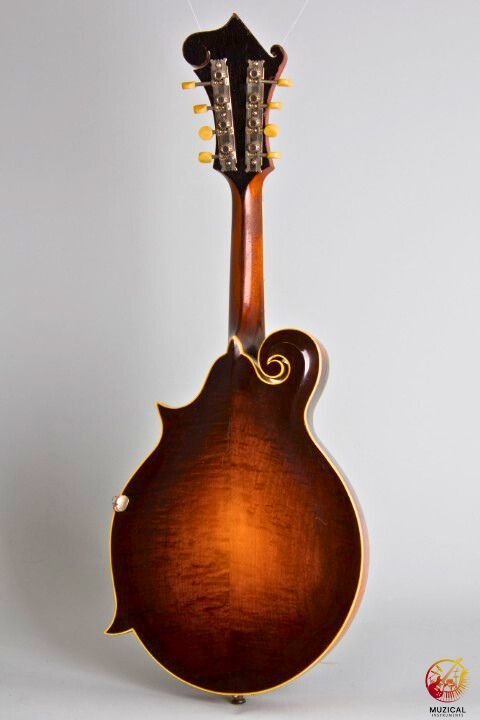
- What they are: These are the mandolins that set the standard, like the “snakehead” Gibson A-models from the 1920s. They have a carved, arched top, like a violin.
- The Good News: These instruments are much stronger. They were built to handle more tension.
- The Rule: A healthy vintage arch-top can usually handle light-gauge bronze strings. You should still avoid medium or heavy gauges unless a luthier says it’s okay.
What’s The Difference: Phosphor Bronze vs. 80/20 Bronze Strings?
When you see “bronze” strings, you are usually looking at one of two main types. The name just tells you the metal alloy wrapped around the steel core wire.
- 80/20 Bronze: This is the original acoustic string. It’s 80% copper and 20% zinc. They sound very bright, crisp, and “zingy” right out of the pack. However, they tend to lose that new sound faster as the metal tarnishes.
- Phosphor Bronze: This alloy is about 92% copper, 8% tin, and a tiny bit of phosphorus. The phosphorus helps prevent corrosion, so the strings last much longer. They have a warmer, richer, and more complex sound.
So, which is better for an old mandolin? It’s a matter of taste, but many players prefer phosphor bronze for an old instrument. The extra warmth often complements the dry, aged wood.
Here’s a quick comparison:
Phosphor Bronze vs. 80/20 Bronze Mandolin Strings
| Feature | 80/20 Bronze Strings | Phosphor Bronze Strings |
|---|---|---|
| Look | Bright, yellow-gold color | Deeper, reddish-gold or orange color |
| Tone | Bright, crisp, clear, “zingy” | Warm, rich, complex, “full-bodied” |
| Lifespan | Shorter. Can sound “dead” quickly. | Longer. Holds tone well. |
| Best For | Cutting through a mix, bright bluegrass | Adding warmth, solo playing, folk |
How Do Bronze Strings Change The Sound Of An Old Mandolin?
Aged wood sounds different from new wood. Over decades, the resins in the wood crystallize, and the wood itself gets lighter and stiffer. This is why vintage instruments are so special, they have a “played-in” sound that is dry, open, and resonant.
- Bronze strings (especially phosphor bronze) can bring out the warmth and complexity of that aged wood. They can give an old mandolin a deep, full voice.
- 80/20 bronze might sound too “thin” or “tinny” on some older mandolins. But on others, they might add a nice “punch” that was missing.
The key is to match the string to the instrument. The goal is a tone improvement for old mandolins, and light bronze strings are often the perfect way to get it.
What String Gauge Should I Use On A Vintage Mandolin?
This is the most important question. Gauge is more important than material.
“Gauge” refers to the thickness of the string, measured in thousandths of an inch. A thicker string means more tension.
- Medium Gauge (e.g., .011, .015, .026, .040): This is the standard for modern bluegrass mandolins. They are LOUD and powerful. Avoid these for most old mandolins.
- Light Gauge (e.g., .010, .014, .024, .038): This is the “safe zone.” These strings have much less tension and are the best place to start for any vintage arch-top.
- Ultra-Light Gauge (e.g., .009, .013, .022, .032): These are even lighter. These are the only strings you should consider for a bowl-back mandolin.
Mandolin String Gauge and Tension Guide
| Gauge Name | Typical E-String | Typical G-String | Total Tension (Approx.) | Best For |
|---|---|---|---|---|
| Medium | .011 or .0115 | .040 or .041 | 180–195 lbs | Modern, strong mandolins |
| Light | .010 | .038 or .036 | 160–175 lbs | Vintage arch-tops (Gibson, etc.) |
| Ultra-Light | .009 | .032 or .034 | 135–150 lbs | Fragile bowl-backs, old flat-backs |
Rule of thumb: When in doubt, start with the lightest strings you can find. You can always move up one step if the instrument feels safe and the sound is too thin. You can’t undo a cracked top.
What Are The Best Low-Tension Strings For Old Mandolins?
If you are worried about tension, bronze strings might not be your only choice. There are other materials specifically designed to be safe for vintage mandolins.
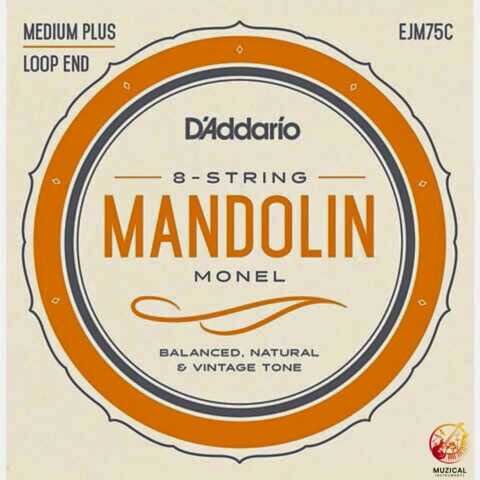
- Monel Strings: These are an alloy of nickel and copper. They were very popular in the mid-20th century. Monel strings have a very different sound from bronze, they are woody, dry, and balanced. Many people feel this is the “authentic” sound for an old Gibson. They are also typically a bit lower in tension than bronze.
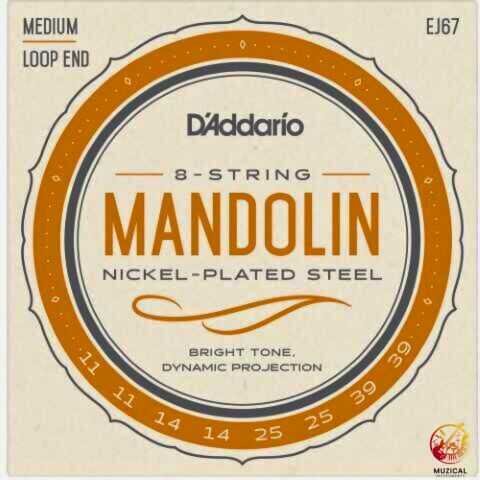
- Nickel-Plated Steel: These have a bright, punchy sound, common on electric guitars but also used for mandolins. They are less complex than bronze.
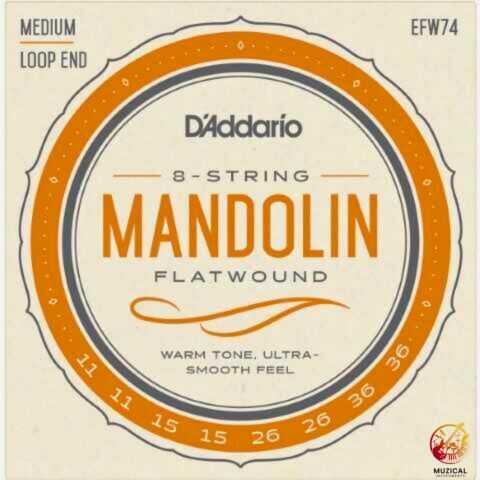
- Flatwound Strings: On these strings, the outer wrap is a flat ribbon. This makes them very smooth to the touch (no “string squeak”) and gives them a dark, thumpy, “old-fashioned” tone. They also tend to be lower in tension.
Here is a table of safe string types for your old instrument.
Safe String Types for Vintage Mandolins
| String Material | Common Gauge | Tone Description | Best For |
|---|---|---|---|
| Light Phosphor Bronze | .010 – .038 | Warm, complex, rich | Vintage arch-tops (A-style, F-style) |
| Light 80/20 Bronze | .010 – .038 | Bright, crisp, “zingy” | Vintage arch-tops that sound too “dark” |
| Monel | .010 – .038 | Dry, woody, fundamental, “vintage” | Getting an authentic 1930s–50s sound |
| Ultra-Light (Any material) | .009 – .034 | Thinner sound, but very safe | All bowl-back mandolins, very fragile flat-backs |
| Flatwound | Light | Dark, smooth, thumpy, “jazz” tone | Reducing finger noise, vintage tone |
How Do I Safely Change Strings On A Fragile Mandolin?
How you change the strings is almost as important as which strings you buy.
Common Mistake: Never, ever cut all eight strings off at the same time.
Your mandolin’s bridge is not glued down. It is held in place only by the string tension. If you remove all the strings, the bridge will fall off. When you put it back, it might be in the wrong place, which ruins your mandolin’s intonation (its ability to play in tune up the neck).
Here is the safe way:
- Change strings in pairs. Remove the two G-strings, clean the area, and install the new G-strings.
- Bring them partly up to tension (just enough to hold them in place).
- Move to the D-strings. Remove the old ones, install the new ones.
- Repeat for the A-strings and E-strings.
- Check your bridge. As you tune, make sure the bridge isn’t leaning. Keep it straight, at a 90-degree angle to the top.
- Once all strings are on, you can slowly tune them all up to pitch.
This method keeps a safe, even amount of tension on the mandolin’s top and neck at all times.
Should I Take My Old Mandolin To A Luthier?
Yes. Absolutely, yes.
If you have an old instrument, the best thing you can do is find a good luthier. A luthier is a professional who builds and repairs stringed instruments.
Ask the luthier to do a “checkup” or a mandolin setup for old instruments.
They will:
- Look inside with a small mirror to check the bracing.
- Check the neck relief (the bow in the neck).
- Check the action (how high the strings are).
- Look for any signs of sinking or cracking.
After this 10-minute check, they can tell you exactly what your instrument can handle. They can give you a precise recommendation for the best string gauges for your vintage mandolin. This small investment can save you from a multi-thousand-dollar repair bill later.
So, Can I Use Bronze Strings On My Old Mandolin?
Do bronze strings work on old mandolins? Yes, as long as you are smart about it. But remember this: The gauge is more important than the material.
Your first step is to identify your mandolin. Is it a fragile bowl-back or a stronger arch-top? Always start with the lightest gauge strings you can find, like a .010 or .009 set. Light-gauge phosphor bronze strings can bring an amazing warmth and life to an old instrument.
When you’re not sure, just ask a luthier. It’s the safest way to protect your piece of history.
FAQ: Do Bronze Strings Work on Old Mandolins?
1. What strings are safe for an old mandolin?
For most old mandolins, light gauge strings are the safest choice. Look for sets where the E-string (the thinnest one) is .010 or smaller. These strings put less pressure on the neck and top. If you have a “bowl-back” mandolin (the kind with a round back), you need even lighter strings, often called “extra-light” or “ultra-light.”
2. Will bronze strings damage a vintage mandolin?
The bronze metal itself won’t hurt the mandolin, but the tension might. Many bronze string sets are “medium gauge,” which pull very hard. This heavy pulling force can warp the neck or crack the top of an old instrument. You can use bronze strings, but you must choose a light gauge set to keep the instrument safe.
3. Can I use regular steel strings on a bowl-back mandolin?
No, this is very risky. Regular steel strings usually have too much tension for a bowl-back mandolin. These instruments were built over 100 years ago for very light strings. If you use modern steel strings, you could collapse the top or break the neck. You should only use strings specifically labeled “light” or “low tension” for these delicate instruments.
4. What is the difference between phosphor bronze and 80/20 strings?
The difference is in the sound.
80/20 Bronze strings look bright yellow. They sound very crisp, bright, and “zingy.”
Phosphor Bronze strings look reddish-orange. They sound warmer and deeper.
Many players prefer phosphor bronze for old mandolins because the warm sound matches the aged wood nicely.
5. How do I tell if string tension is too high?
Your mandolin will show you warning signs. Watch for these three things:
The neck starts to bow forward, making the strings sit very high above the fretboard.
The bridge starts to tip or lean forward.
The top of the mandolin (under the bridge) starts to sink down.
If you see any of these, loosen the strings right away to stop the damage.