Mountain Dulcimer vs Hammered Dulcimer: What’s the Difference?

The debate between the mountain dulcimer vs hammered dulcimer often confuses new folk musicians.
They share the same name, but they’re two very different instruments with unique sounds, shapes, and ways of playing.
If you’re trying to decide which one to learn, you must know how they differ in shape, playing style, sound and beginner-friendliness.
In this guide, we will explore the difference between mountain and hammered dulcimer instruments. You will learn about their shape, their sound, and how you play them.
By the end, you’ll know exactly which dulcimer fits you best.
What is a “Dulcimer” Anyway?
The name “dulcimer” comes from the Latin dulcis (sweet) and the Greek melos (sound). So, it just means “sweet sound.”
This is why two very different instruments can share the name. They both make a “sweet sound.”
Both instruments are part of the larger zither family. A zither is just any instrument with strings stretched across a soundbox. A piano is a zither. A harpsichord is a zither.
But that’s where the similarities stop. Let’s look at the first instrument.
What Is a Mountain Dulcimer?
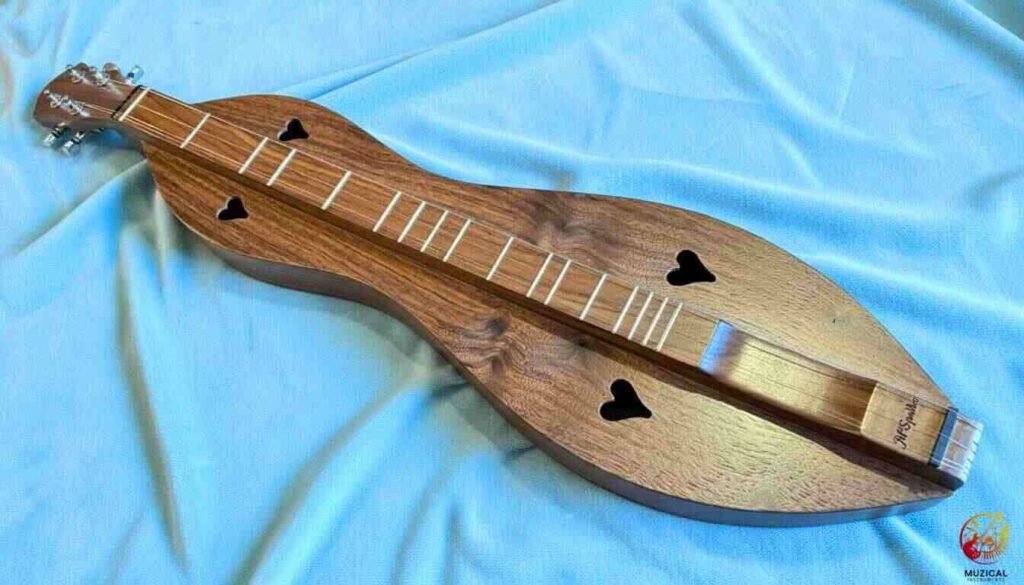
The mountain dulcimer is the instrument most people think of when they hear folk dulcimer instruments from the United States.
It is also called the Appalachian dulcimer. This name is a big clue. This instrument was born in the Appalachian mountains of the eastern U.S. in the 19th century.
It’s a true American folk instrument. It was played by settlers and became a huge part of the folk music revival, thanks to musicians like Jean Ritchie.
The Look and Shape
The mountain dulcimer is long and thin. It’s designed to sit on your lap.
- Shape: It usually has an “hourglass” shape, like a skinny guitar. It can also be a “teardrop” shape or just a simple long box.
- Size: It’s portable. You can easily pick it up, put it in a case, and take it to a friend’s house.
- Soundbox: The body is a hollow “soundbox” that makes the music louder.
The Strings and Frets
This is the most important part.
- Strings: Mountain dulcimers usually have 3 or 4 strings. They are very simple.
- Frets: The strings are stretched over a “fretboard,” just like a guitar. These are the little metal bars that you press the strings on to change the note.
But here is the big secret to the mountain dulcimer: The frets are diatonic.
What does that mean? It means they are set up to play a “do-re-mi” scale. It’s like only having the white keys on a piano.
This design choice is brilliant. It makes it almost impossible to play a “wrong” note. Any note you play will sound good with the others. This is why it’s so popular for beginners.
What Is a Hammered Dulcimer?
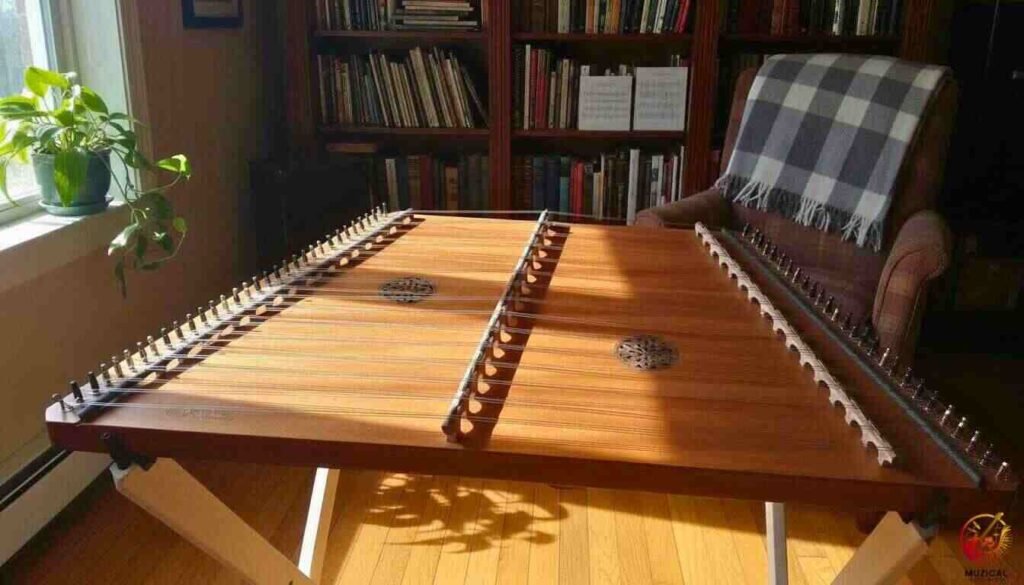
Now, let’s look at the other “dulcimer.” The hammered dulcimer is a completely different beast.
While the mountain dulcimer is a new, American instrument, the hammered dulcimer is ancient. It has relatives all over the world, from Persia (the santur) to China (the yangqin).
It’s a percussion instrument. You don’t strum it. You strike it.
The Look and Shape
The hammered dulcimer is a large, flat box.
- Shape: It is a trapezoid. This means it’s wider at the bottom and narrower at the top.
- Size: It’s big. It’s not a lap instrument. You have to put it on a stand or a table to play it.
- Soundbox: The entire body is a large, resonant soundbox.
The Strings and Bridges
This is where things get complex. A hammered dulcimer has a lot of strings.
- Strings: A beginner model might have 60 strings. A large one can have over 120.
- Courses: The strings are grouped in “courses.” A course is a set of 2 or 3 strings that are all tuned to the same note. This is what gives it a loud, ringing sound.
- Bridges: The strings are stretched over two main bridges:
- Treble Bridge: The bridge on the right (usually).
- Bass Bridge: The bridge on the left.
The bridges are the “map” of the instrument. To find the right note, you have to know which side of which bridge to strike. It’s not laid out in a simple line like a piano.
Dulcimer Comparison Guide: At a Glance
The easiest way to see the difference between mountain and hammered dulcimer is side-by-side.
Mountain Dulcimer vs. Hammered Dulcimer
| Feature | Mountain Dulcimer | Hammered Dulcimer |
|---|---|---|
| Common Name | Appalachian Dulcimer, Lap Dulcimer | Hammer Dulcimer |
| How You Play | Strum or pick with fingers/pick | Strike with small “hammers” (mallets) |
| Where You Play | Sits on your lap | Sits on a stand or table |
| Shape | Long, thin, hourglass or teardrop | Large, flat, trapezoid |
| Number of Strings | 3 to 4 (sometimes 5 or 6) | 60 to 120+ (in “courses”) |
| Fretboard | Yes, has frets | No, it is a fretless instrument |
| Scale | Diatonic (like a piano’s white keys) | Chromatic (like all piano keys) |
| Origin | Appalachia, USA (19th Century) | Ancient, Persia / Middle East |
| Common Music | Folk, ballads, singer-songwriter | Celtic, world music, orchestral, folk |
How Do You Play a Mountain Dulcimer?
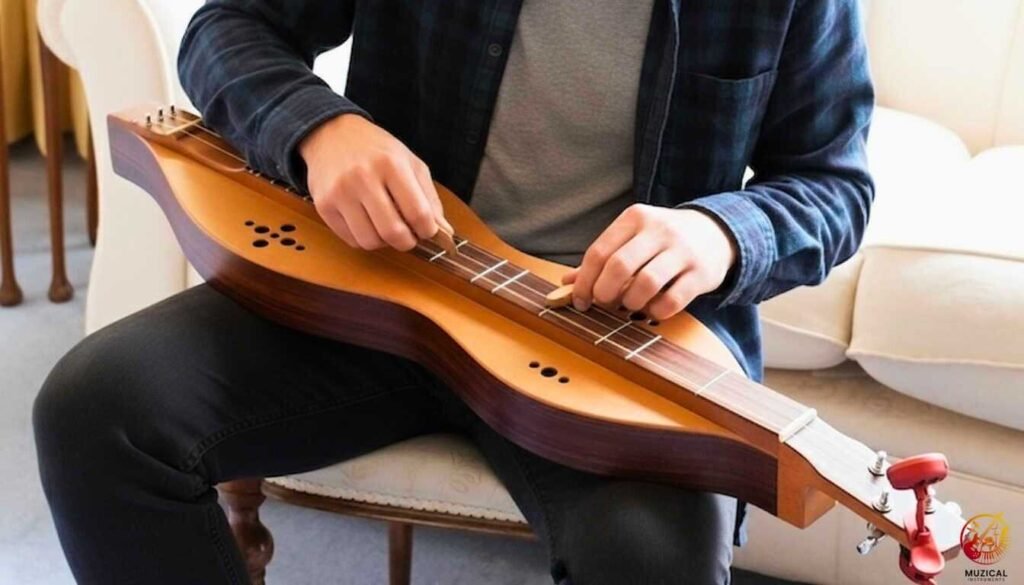
Playing the mountain dulcimer is simple and relaxing.
- You place it on your lap. The “head” (with the tuning pegs) is to your left.
- You strum. You use a pick or your fingers to strum all the strings with your right hand, creating a steady rhythm.
- You play the melody. With your left hand, you press down on the string closest to you. This is the melody string.
Because of the diatonic frets, you can even use a small wooden stick called a “noter” to slide up and down the melody string. This creates that classic, sliding, folky sound.
The other strings, which you don’t press, are called drone strings. They just play the same background note over and over. This drone is what gives the mountain dulcimer its haunting, traditional sound.
Modern players often skip the noter and use their fingers to press all the strings, allowing them to play full chords.
How Do You Play a Hammered Dulcimer?
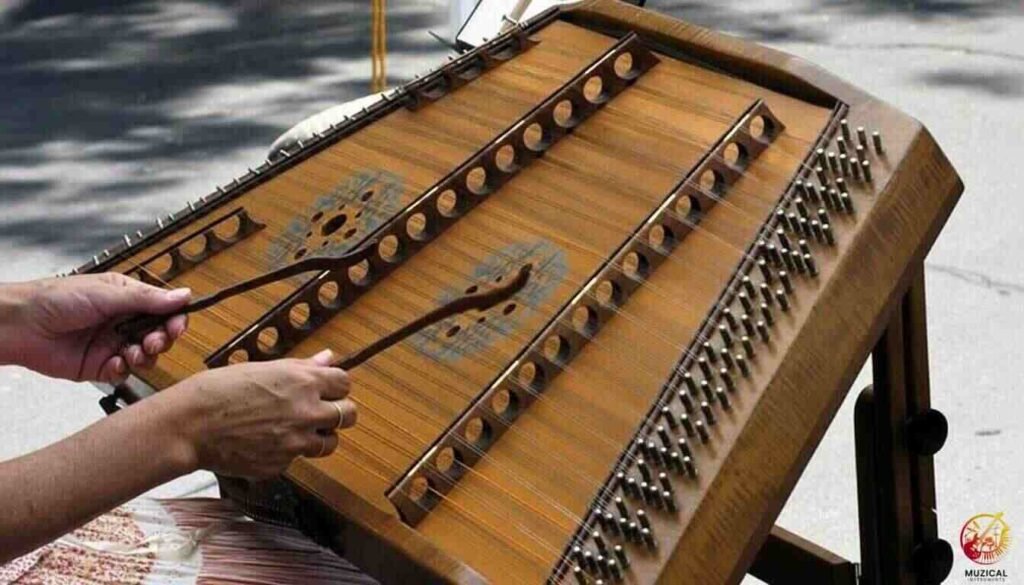
Playing the hammered dulcimer is very different. It’s active and physical.
- You stand or sit in front of the instrument, which is on its stand.
- You hold hammers. You hold one small “hammer” (or mallet) in each hand. These are usually made of wood and can have felt or leather on the ends.
- You strike the strings. You hit the string “courses” to make a note.
The biggest challenge for a beginner is learning the “map.” The notes are not in a simple row. The C scale is on the treble bridge. The G scale is on the bass bridge. Other notes are found in different spots.
It’s a very visual and spatial instrument. You have to see the pattern and strike the right spot. It’s much more like playing the drums or a xylophone than a guitar.
Once you learn the map, you can play incredibly fast, complex music, flying across the strings with both hammers.
Hammered Dulcimer vs Mountain Dulcimer Sound
This is the most important part of the mountain dulcimer vs hammered dulcimer question. They sound nothing alike.
The Mountain Dulcimer Sound
The mountain dulcimer is quiet, soft, and personal.
It’s an intimate instrument. It was made to be played in a quiet room, on a porch, or to accompany a single singer.
- The sound is simple.
- The drone strings give it a full, buzzing background.
- It’s perfect for singing old folk songs and ballads.
The Hammered Dulcimer Sound
The hammered dulcimer is loud, bright, and shimmering.
When you strike a course of strings, the sound rings out and fills the room. It has a long “sustain,” meaning the notes hang in the air for a long time.
- The sound is complex and rich.
- It sounds almost like a piano, a harp, or a harpsichord.
- It’s a “performance” instrument. It can be heard in a noisy pub or with a full band.
Comparing the Sounds
| Sound Quality | Mountain Dulcimer | Hammered Dulcimer |
|---|---|---|
| Volume | Quiet | Loud |
| Sustain (How long notes ring) | Short | Long and ringing |
| Texture | Simple, buzzing, folksy | Complex, shimmering, bright |
| Best For | Singing along, playing solo | Fast tunes, playing in a band |
| Vibe | Relaxing on the front porch | A lively Celtic music session |
Which Dulcimer is Easier for Beginners?
This is the most-asked question.
The best dulcimer for beginners is, without a doubt, the mountain dulcimer.
Why the Mountain Dulcimer is Easier:
- No “Wrong” Notes: The diatonic fretboard is a safety net. You can strum and press any fret, and it will sound like you’re playing a real song. This gives you instant success, which is very motivating.
- Fewer Strings: You only have to worry about 3 or 4 strings. Tuning is fast and easy.
- Simple Action: Strumming is a natural motion. Pressing one string is simple.
- Portability: It’s easy to store, carry, and practice anywhere.
You can buy a mountain dulcimer and be playing a simple song like “Twinkle, Twinkle, Little Star” in less than 20 minutes.
The Hammered Dulcimer Challenge
The hammered dulcimer is much harder to start.
- The Note Map: You have to memorize where all the notes are. There are no frets to guide you. You will hit a lot of wrong notes at first.
- Tuning: A 12/11 dulcimer (a common beginner size) has 23 courses of strings… and many have 2-3 strings per course. That’s over 60 strings to tune. Tuning can take 15-30 minutes, and you have to do it often.
- The Hammers: Learning to hold the hammers, control your “bounce,” and strike accurately takes practice.
The hammered dulcimer is a very rewarding instrument, but it has a much steeper learning curve.
Common Beginner Mistakes
| Instrument | Common Mistake | How to Avoid It |
|---|---|---|
| Mountain Dulcimer | Tuning too high. | Always use an electronic tuner. Most dulcimers use D-A-A or D-A-D tuning. Tuning too high (like a guitar) will snap the strings. |
| Mountain Dulcimer | Pressing too hard. | The frets on a dulcimer are often high. You only need a light touch. Pressing too hard will pull the note sharp (out of tune). |
| Hammered Dulcimer | Getting “lost.” | Put markers on your bridges! Use small, colored stickers or a marker to label your “C” notes. This helps you find your way on the “map.” |
| Hammered Dulcimer | Playing with “stiff” wrists. | The sound comes from a light, quick “bouncing” of the hammer. Don’t “pound” the strings with your arms. Let your wrists do the work. |
Dulcimer Buying Guide: A Quick Tip
When you are ready to buy, remember this:
- For a Mountain Dulcimer: Start with a 4-string model with an hourglass shape. A solid wood top (like spruce or cedar) will sound better than a cheap laminate one. A simple, well-made instrument is all you need.
- For a Hammered Dulcimer: Don’t buy the biggest one! Start with a “12/11” model. This means it has 12 courses on the treble bridge and 11 on the bass. This is the standard “beginner” size. You will also need to buy a stand, a tuning wrench, and a good electronic tuner.
Appalachian Mountain Dulcimer vs Hammered Dulcimer: The Final Verdict
So, what is the final word on Appalachian mountain dulcimer vs hammered dulcimer?
They are two separate, wonderful folk dulcimer instruments.
The Appalachian Mountain Dulcimer is your perfect starting point. It’s a quiet, personal, simple instrument. If you want to sing songs, relax, and connect with American folk music, this is your instrument.
The Hammered Dulcimer is a powerful, beautiful, and complex instrument. It’s a “world” instrument. If you love the bright, ringing sound of Celtic music and want an instrument that can be the star of the show, this is your choice.
The mountain dulcimer vs hammered dulcimer question isn’t about which is “better.” It’s about which “sweet sound” is calling to you.
Do you want to strum on your lap, or strike strings with hammers?
Now that you know the difference, you can make the right choice and start your musical journey.
FAQ: Mountain Dulcimer vs Hammered Dulcimer
1. What is the main difference between a mountain dulcimer and a hammered dulcimer?
The main difference is how you play them.
You play a mountain dulcimer (also called an Appalachian dulcimer) by placing it on your lap. You strum or pick the 3 or 4 strings, much like a simple guitar.
You play a hammered dulcimer by setting it on a stand. You strike its many strings (often 60 or more) with two small mallets called “hammers.”
2. Which dulcimer is easier to learn for a beginner?
The mountain dulcimer is much easier for beginners. It has only a few strings and a special fretboard (called diatonic). This fretboard is set up so it’s almost impossible to play a “wrong” note. Most people can learn a simple song in just a few minutes.
3. Is a hammered dulcimer hard to play?
Yes, the hammered dulcimer is harder to learn. It has no frets and a large number of strings. The biggest challenge for a beginner is memorizing where all the different notes are. It also takes practice to learn how to hold and control the hammers properly.
4. What kind of music is a mountain dulcimer used for?
The mountain dulcimer is most famous for playing American folk music. Its quiet, gentle sound was perfect for songs and ballads from the Appalachian mountains. It is a wonderful instrument for singing along with.
5. Do you strum or pick a hammered dulcimer?
No, you do not strum or pick a hammered dulcimer. It is a type of percussion instrument. You play it by striking the strings with the “hammers.” This hitting action is what creates its bright, ringing sound, which is very different from the strum of a mountain dulcimer.