What Is an Appalachian Mountain Dulcimer? A Beginner’s Guide

The Appalachian Mountain Dulcimer is a stringed instrument that is a true piece of American history. It is a core part of traditional Appalachian music instruments and is famous for one big reason: it is one of the easiest stringed instruments you can learn to play.
It has a quiet, sweet sound that is perfect for folk songs and ballads.
In this guide, you will learn what a mountain dulcimer is, where it came from, how to play it, and how to choose the right one for you. We will cover its parts, its unique tuning, and the common mistakes beginners make.
What Makes a Mountain Dulcimer Different?


The Appalachian Mountain Dulcimer (also called a “lap dulcimer“) is a type of fretted zither.
Let’s break that down:
- Zither: This is a large family of instruments that have strings stretched across a flat soundbox (the body).
- Fretted: It has a fingerboard with raised metal strips called frets. These frets show you exactly where to press the string to get a new note.
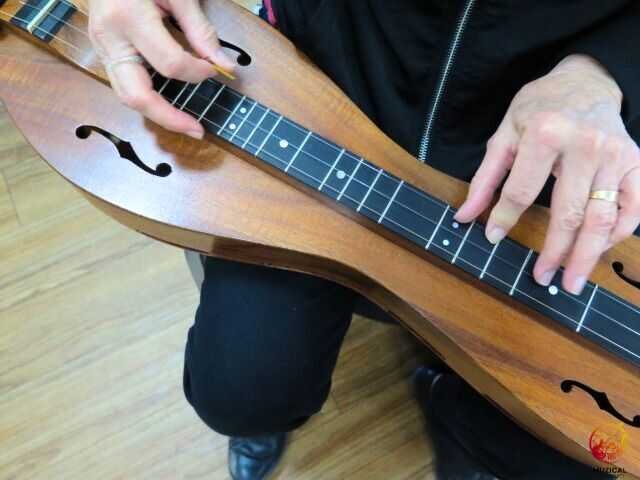
Unlike a guitar, which you hold upright, the dulcimer is played sitting flat on your lap. This “lap” position is why it’s also called a lap dulcimer.
You play it by strumming all the strings at once with your right hand while pressing down on the melody string(s) with your left hand. This creates a “drone” sound, where one note (the melody) moves while the other strings provide a constant, humming background. It sounds a lot like a bagpipe, but much softer.
Where Did the Appalachian Dulcimer Come From?
This instrument doesn’t come from ancient times. The Appalachian dulcimer history is a truly American one, starting in the early 1800s.
It was created by early settlers in the Appalachian Mountains, especially in states like Kentucky, Virginia, and West Virginia. These communities were often very isolated.
The settlers, mainly of Scots–Irish and German descent, wanted to make music. They brought memories of instruments from their home countries, like the German Scheitholt or the Scandinavian Langeleik. They didn’t have fancy tools or workshops, so they used the wood they had often walnut, cherry, or poplar to build their own simple instruments.

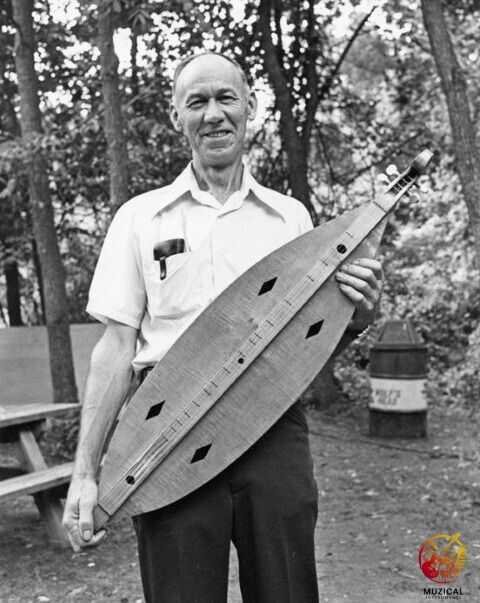
The Appalachian Mountain Dulcimer was born from this. It was a true dulcimer folk instrument, built by families to be played in their homes, at church gatherings, and on their porches.
It almost faded away, but it was saved during the American folk music revival of the 1950s and 1960s. Artists like Jean Ritchie, a Kentucky native, brought the dulcimer to audiences all over the world. Today, it is a beloved symbol of American folk heritage.
Mountain Dulcimer vs. Hammered Dulcimer: What’s the Difference?
This is the number one point of confusion for beginners. The “dulcimer” name is used for two completely different instruments.
The Appalachian Mountain Dulcimer is the one we are talking about. It’s small, sits on your lap, and has frets.
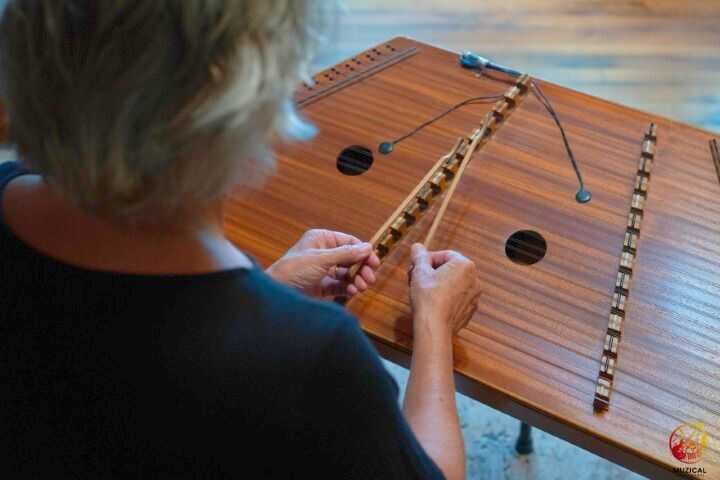
The Hammered Dulcimer is a totally different beast. It’s a large, trapezoid shaped zither that sits on a stand. It has no frets. You play it by striking the many strings with small wooden “hammers” or mallets.
Here is a simple breakdown.
Mountain Dulcimer vs. Hammered Dulcimer
| Feature | Appalachian Mountain Dulcimer (Lap Dulcimer) | Hammered Dulcimer |
|---|---|---|
| How It’s Played | On the lap. Strummed or picked with a plectrum (pick). | On a stand. Struck with small “hammers.” |
| Fingering | Has frets. You press strings with fingers or a “noter.” | Has no frets. You just strike the open strings. |
| Size & Shape | Small, long, and narrow. Hourglass or teardrop shape. | Large and wide. Trapezoid (trapezoidal) shape. |
| Family | Fretted Zither | Unfretted Zither / Box Zither |
| Sound | Quiet, sweet, with a drone. | Loud, ringing, and complex. Sounds like a piano. |
| Typical Music | Folk ballads, hymns, simple melodies. | Folk, orchestral, complex arrangements. |
If you want to sing along to a simple folk song, you want the Appalachian Mountain Dulcimer.
What Are the Parts of a Mountain Dulcimer?
A dulcimer looks simple, and its parts are easy to learn.
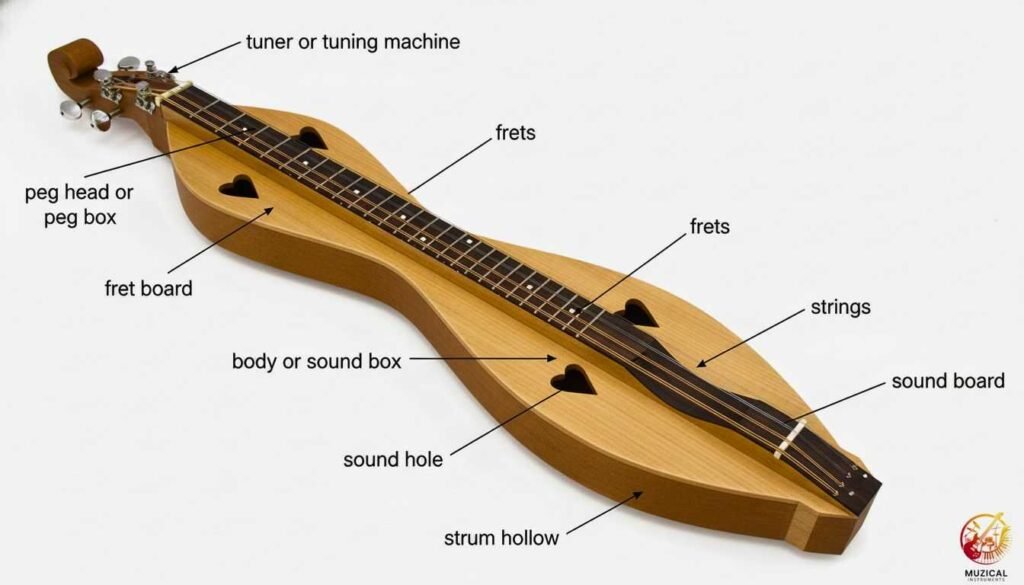
- Headstock: This is at the top. It holds the tuning pegs.
- Tuning Pegs: These are the knobs or pins you turn to tighten or loosen the strings. This changes the pitch (the note).
- Nut: A small piece of wood or bone where the strings pass from the headstock to the fingerboard. It sets the string spacing.
- Fingerboard (or Fretboard): This is the raised part of wood that sits on top of the main body. The frets are set into this.
- Frets: These are the raised metal strips. Each fret is one note.
- Strings: This is what you strum! We’ll talk about how many in a moment.
- Soundbox (or Body): This is the main hollow part of the instrument. It makes the sound loud and warm.
- Sound Holes: The openings on the top of the soundbox that let the sound out. These are often cut into beautiful shapes, like hearts, f-holes (like a violin), or trees.
- Bridge: A small piece of wood near the bottom. The strings rest on it. It transfers the string’s vibration into the soundbox.
- Tailpiece: This is at the very bottom. It holds the end of the strings in place.
How Many Strings Does a Dulcimer Have?
This can be confusing. You will see dulcimers advertised with 3 strings or 4 strings.
Here is the simple answer: They are almost the same thing.
- 3-String Dulcimer: Has three single strings. A bass string, a middle string, and a melody string.
- 4-String Dulcimer: This setup usually has three courses (or groups) of strings.
- One single bass string.
- One single middle string.
- A double melody string. This means two strings are placed very close together and are tuned to the exact same note.
Why do this? That double string gives the melody a brighter, louder, and fuller sound. It’s very common and popular.
As a beginner, you play this 4-string dulcimer exactly the same as a 3-string. You just press down on both melody strings at the same time as if they were one.
Is the Mountain Dulcimer Hard to Learn?
This is the best part: No.
The Appalachian Mountain Dulcimer is one of the easiest, most rewarding instruments for a total beginner.
The secret is its diatonic fretting.
This sounds like a scary term, but it’s simple.
- A chromatic instrument (like a guitar or piano) has all the possible notes.
- A diatonic instrument (like a mountain dulcimer or a harmonica) only has the notes for one specific scale.
Think of it this way: a diatonic dulcimer is like playing only the white keys on a piano. You get the “Do-Re-Mi-Fa-Sol-La-Ti” notes. The “wrong” notes (the black keys) are simply not there.
Because the frets are diatonic, it is almost impossible to play a note that sounds bad. You can slide your finger up and down the melody string, and it will just… play a song. This makes it a perfect mountain dulcimer for beginners. You can make music in your very first session.
How Do You Actually Play It?
The how to play Appalachian dulcimer part is fun and has two main styles. You will need a plectrum (a guitar pick) to start.
First, place the dulcimer on your lap, with the headstock to your left.
1. Traditional “Noter” Style
This is the classic way to play.
- Left Hand: You don’t use your fingers. You hold a small wooden stick or dowel called a noter.
- Right Hand: You strum all the strings at once with your pick, back and forth.
- To play: You slide the noter up and down the melody string (the one closest to you). The other two strings (the drones) keep ringing out the same note.
This is what creates that classic, haunting, “bagpipe” drone sound. It’s simple and beautiful.
2. Modern “Chord” Style
This style is played more like a guitar.
- Left Hand: You use your fingers (your index, middle, and ring finger) to press down on the strings.
- Right Hand: You still strum all the strings.
- To play: You can press down on different strings to form chords (multiple notes played at once).
This style is great for playing more complex songs or for singing along. Most players today learn to do both.
Traditional vs. Modern Playing Style
| Style | Left Hand | Right Hand | The Sound | Best For… |
|---|---|---|---|---|
| Traditional (Noter) | Holds a “noter” (stick) to slide on the melody string. | Strums all strings (including drones) back and forth. | Simple melody over a constant, ringing drone. | Traditional folk ballads, “Old Joe Clark,” “Amazing Grace.” |
| Modern (Chord-Melody) | Uses fingertips to press down on different strings. | Strums all strings, or fingerpicks individual strings. | Full chords and complex melodies. | Pop songs, singing accompaniment, modern folk. |
As a beginner, start with the noter style. It’s easier and will build your confidence.
What Is a Traditional Mountain Dulcimer Tuning?
A mountain dulcimer tuning guide is simple because most players use one or two main tunings. The dulcimer is a modal instrument, meaning its tunings are set up for different “moods” or scales from old folk music.
The most common tuning by far is D-A-A (Ionian).
This means:
- The bass string (farthest from you) is tuned to D.
- The middle string is tuned to A.
- The melody string(s) (closest to you) are also tuned to A (one octave higher).
You will need a small digital chromatic tuner to do this. Just clip it to the headstock.
Why D-A-A? This tuning makes it incredibly easy to play songs in the key of D major. Many simple folk songs, hymns, and fiddle tunes are in this key.
Another popular tuning is D-A-D (Mixolydian). This gives the instrument a more bluesy, “old-timey” feel. But when you are just starting, stick to D-A-A.
What Kind of Music Can You Play?
The dulcimer is a dulcimer folk instrument at its core. It is perfect for:
- Appalachian folk songs
- Old-time fiddle tunes
- Traditional ballads
- Hymns and gospels (“Amazing Grace” is often the first song people learn)
- Christmas carols
But it’s not limited to that! The folk artist Joni Mitchell famously used the Appalachian dulcimer in many of her most famous songs, like “A Case of You.” Modern players use it for pop, blues, and even rock.
A Quick Dulcimer Buying Guide
Are you ready to buy one? Finding the best Appalachian mountain dulcimer for a beginner is easy if you know what to look for.
Avoid the cheapest
Be very careful of instruments under $100. They are often “wall-hangers” (meant for decoration) and won’t play in tune.
Expect to spend $150 – $300
This is a great range for a high-quality, American-made beginner model that will last you for years.
Laminate vs. Solid Wood
Cheaper dulcimers are made of laminate (plywood). This is fine for a starter. More expensive ones have a solid wood top (like walnut, cherry, or spruce). Solid wood sounds much warmer and richer as it ages.
Shape
You will see two main shapes: hourglass and teardrop. The difference is mostly cosmetic. The hourglass is the traditional shape, while the teardrop can sometimes have a slightly brighter tone. Pick the one you think looks best.
Where to Buy
Your best bet is a local music store that specializes in folk instruments. If you buy online, buy from a dedicated luthier (instrument builder) or a reputable folk music website, not a big-box store.
Beginner Dulcimer Buying Guide
| Material | Price Range | Who Is It For? |
|---|---|---|
| Laminate / Plywood | $120 – $200 | The absolute beginner. Great for testing the waters and is very durable. |
| Solid Wood Top | $200 – $400 | The serious beginner. The top is solid wood, but the back/sides are laminate. This is the “sweet spot” for value. |
| All Solid Wood | $400+ | The dedicated player. Made entirely of solid walnut, cherry, etc. A “forever” instrument with a beautiful, rich tone. |
What Are Common Mistakes Beginners Make?
- Not Tuning: Being afraid to tune the instrument. You must tune it every single time you play. A clip-on tuner is your best friend.
- Pressing Too Hard: You don’t need to press hard with the noter or your fingers. A light touch is all you need. Pressing too hard will make the note sound sharp (out of tune).
- Hunching Over: It’s easy to hunch over your lap. This will make your back hurt. Try placing the dulcimer on a table in front of you instead.
- Strumming Too Hard: The dulcimer is a quiet, gentle instrument. A light, steady strum is all you need.
- Giving Up: The first 10 minutes might feel strange, but don’t stop. Once your hand learns where “Do-Re-Mi” is, it will click.
The Final Takeaway
The Appalachian Mountain Dulcimer is a wonderful, charming instrument that connects you directly to American folk history.
It is not difficult or expensive. It is a joyful, relaxing instrument designed to be played by anyone, right from the first day. The main takeaway is this: you don’t need years of lessons to make beautiful music.
If you want a simple, beautiful, and rewarding musical hobby, the mountain dulcimer is a perfect choice.
FAQ: What Is an Appalachian Mountain Dulcimer?
1. Do I need to learn to read music to play the dulcimer?
No, you do not! Most people learn to play the mountain dulcimer using something called “tablature” (or “tab”). This is a simple set of diagrams that shows you which fret to press and which string to strum. It’s a number based system that is very easy to learn, even if you have no musical background at all.
2. What is the “6 1/2 fret” I see mentioned on some dulcimers?
A traditional dulcimer only has the notes of a major (Ionian) scale. As players got more advanced, they wanted to play more types of songs. Luthiers (instrument makers) added an extra fret between the 6th and 7th frets, called the “6 1/2 fret” or “6+ fret.” This extra note lets you easily play in a different scale (the Mixolydian mode) and play more complex tunes. Most beginner instruments have it, but it’s not essential for your very first songs.
3. What accessories do I really need to get started?
You don’t need much, which is great! Besides the dulcimer itself, you will only need three things:
A Plectrum (Pick): A standard guitar pick works great.
A Digital Tuner: A small “clip-on” tuner is the easiest. You clip it to the headstock to make sure your strings are in tune.
A Case or Gig Bag: This is very important for protecting your instrument from dust, bumps, and changes in humidity.
4. How should I care for and clean my dulcimer?
Taking care of your dulcimer is simple. Keep it in its case when you’re not playing it. Use a soft, dry microfiber cloth to wipe fingerprints and dust off the wood and strings after you play. The biggest danger is humidity: never leave your instrument in a hot car or a damp basement. Try to keep it in a room where you are comfortable.
5. Can you use a bow (like a violin) on a mountain dulcimer?
Yes, you can! This is a less common but beautiful way to play. Players who do this often use a “bowed dulcimer,” which may have a slightly different shape or a raised bridge to make it easier to play one string at a time. But you can experiment with a bow even on a standard dulcimer for a long, sweet, singing sound.
Cripple Creek – Mountain Dulcimer